How Many Jobs Should I Apply To Per Day? 2026 Data

For most job seekers, 3–8 applications per day is the realistic target. The exact number depends on your field, your interview goal, and how many weeks of runway you have. Pick your field in the calculator below and it does the math.
TL;DR: Realistic daily targets (3 interviews over 6 weeks)
- Software / Tech: ~5 per day (~156 total). Brutal, but the data doesn't care about your feelings.
- Automotive / Trades: ~6 per day (~189 total)
- Sales / Marketing / Ops: ~3 per day (~99 total)
- Education & Childcare: ~1–2 per day (~45 total)
- Healthcare: ~1 per day (~39 total)
- Senior / PM / Data Science: Less than 1 per day (~24 total). Send when the right role appears, not on a schedule.
- Employed and searching quietly: 1–2 per day regardless of field. Trade volume for targeting.
Based on a ~1.9% application-to-interview rate in Software / Tech.
The manual volume math
If you're targeting 3 interviews in tech and have 6 weeks of runway, the calculator lands you at ~5 sends per day. At 15 minutes each, that's 75 minutes of focused application work: sustainable, with time left over for follow-ups and one warm-intro DM (worth ~15 cold sends, as the source table shows).
Sending 20 per day gets you to interviews burned out, with worse targeting on every single send. 72% of job seekers report the search hurts their mental health, driven mostly by long timelines and the feeling of shouting into a void. Keeping your daily count realistic is what holds a two-to-three month search together.
Reality check from Huntr's data: Half of job seekers submit 5 or fewer resumes per week. Three-quarters stay at 11 or fewer. 90% cap out at 22 per week. The "hustle and apply to 100 per day" advice isn't how most successful searches actually go.
How many jobs should you apply to per day: calculate your target
Every "apply X per day" guide skips the step that matters: figuring out how many total you need. Get that number first, divide by your runway, and the daily target becomes arithmetic.
The three inputs are:
- Target interviews. Most candidates get an offer after 2–4 interviews, so 3 is a reasonable working number.
- Applications per interview in your field. This varies enormously, and we'll break it down below.
- Working weeks of runway. If you're employed and searching quietly, you might have 12 weeks. If you just got laid off with two months of savings, you have six.
Multiply the first two, divide by (runway weeks × 5 working days), and that's your number. The calculator above does this live.
What one interview costs, by field
CareerPlug's 2025 Recruiting Metrics Report analyzed 10 million hiring records across 60,000+ US employers and found the overall interview conversion rate sits at 3% for 2024 activity. That's one interview for every 33 submissions on average. Cross-referencing with Pin's 2026 Recruitment Funnel Benchmarks and Ashby's 2026 Talent Trends Report (54M+ data points), the industry breakdown holds consistent:
| Field | App-to-interview rate | Apps per 1 interview | Source |
|---|---|---|---|
| Software / Tech | ~1.9% | ~52 | Pin/Ashby 2026 |
| Automotive / Trades | ~1.5% | ~63 | Pin/Ashby 2026 |
| Sales / Marketing / Ops | ~3% | ~33 | Pin/Ashby 2026 |
| Education & Childcare | ~6.3% | ~15 | Pin/Ashby 2026 |
| Healthcare | ~7.7% | ~13 | Pin/Ashby 2026 |
| Senior / PM / Data Science | ~10–15% | ~7–10 | Pin Benchmarks 2026 |
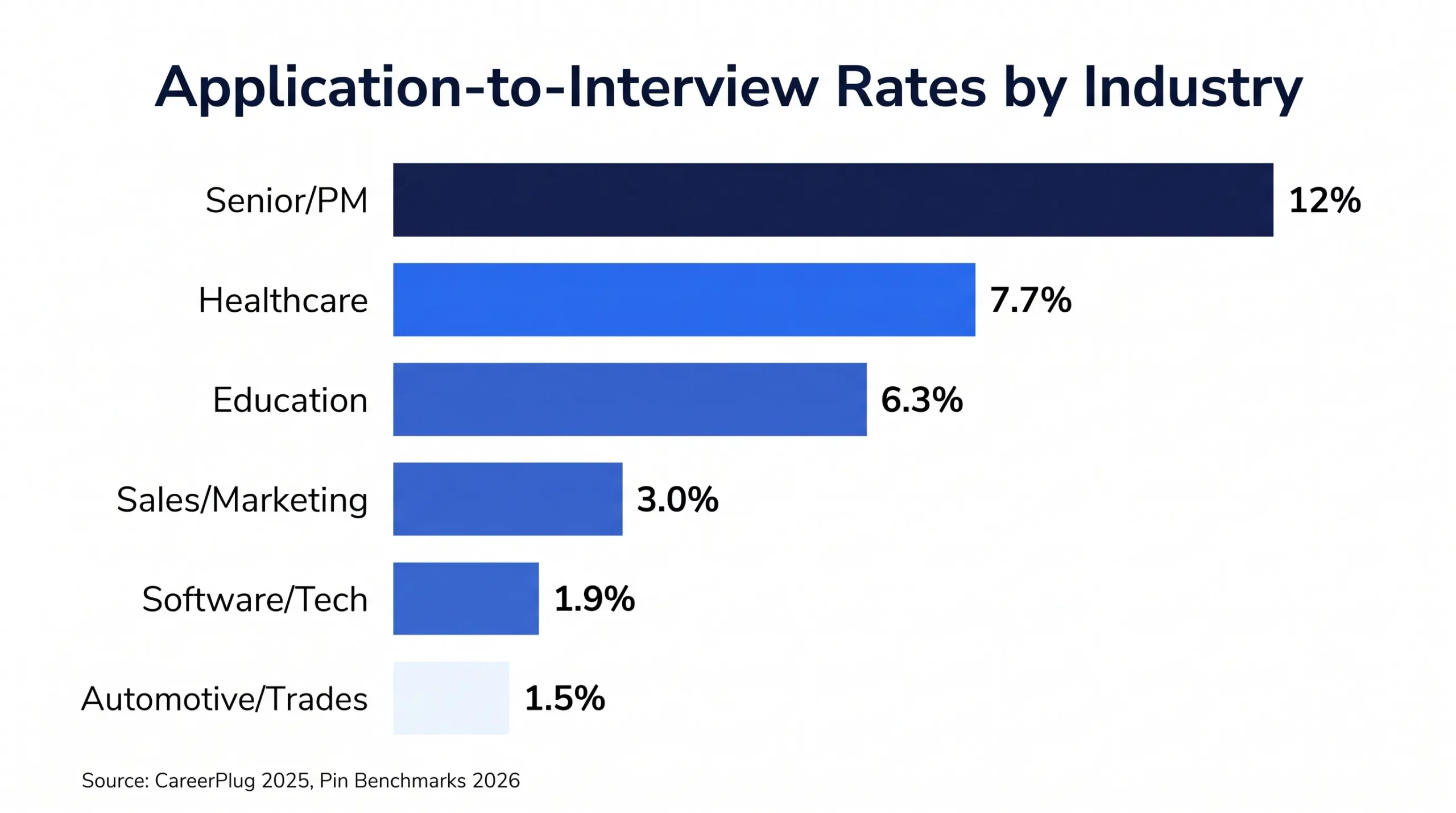
Tech is genuinely rough: one interview costs ~52 sends. The LinkedIn influencer who told you to "just network harder" applied to 200 roles before landing their job. They just didn't post about that part. Healthcare runs differently: 13 per interview means you're leaving callbacks on the table if you spend your whole day applying.
How many applications does it take to get a job?
Around 100 total, as a median. According to a 2025 compilation by The Interview Guys pulling from multiple tracking studies, the full range from first send to signed offer runs 32 to 200+ applications, depending on field, seniority, and how well the resume is targeted.
- Median: ~100 applications before a signed offer.
- Range: 32 to 200+, with tech and trades at the high end, healthcare and education at the low end.
- Competition: 244 candidates per opening on average (Greenhouse 2026), so a single-digit application total is a lottery ticket, not a plan.
Spread that total across your runway and you get the daily number. That's the whole logic of this page.
How many jobs should you apply to per week
If you're planning by the week (most people do), just multiply the daily target by 5 working days. Here's what that looks like for each field at a 3-interview target:
| Field | Per day | Per week | Focused hours/week |
|---|---|---|---|
| Software / Tech | ~5 | ~25 | ~6.3 hrs |
| Automotive / Trades | ~6 | ~30 | ~7.5 hrs |
| Sales / Marketing / Ops | ~3 | ~15 | ~3.8 hrs |
| Education & Childcare | ~1–2 | ~7 | ~1.8 hrs |
| Healthcare | ~1 | ~5 | ~1.3 hrs |
| Senior / PM / Data Science | <1 | ~3–4 | ~1 hr |
Huntr's Q1 2025 dataset shows half of active seekers submit 5 or fewer resumes per week and 90% cap at 22. That's roughly the sales/marketing tier. If you're in tech and hitting 5/week, you're going to miss your timeline: the math needs ~25.
How many jobs to apply to per day when unemployed (vs. employed)
- Unemployed, searching full-time: work the top of your field's range. In tech that means 5–8 per day. The search is your job right now, and runway math is unforgiving.
- Employed, searching quietly: 1–2 per day is enough. You have a longer runway, so spend the saved hours on targeting and referrals instead of raw volume.
Same formula in both cases. What changes is the runway: 6 weeks of savings forces a higher daily number than a 12-week quiet search ever needs.
Response rate by application source (this matters more than volume)
Every rate above assumes a cold online submission. Change the source and the math changes by an order of magnitude. From Zippia's referral analysis and cross-referenced hiring data:
| Application source | Success rate | Relative to cold apply |
|---|---|---|
| Employee referral | ~30–40% | ~18x more likely to hire |
| Recruiter-sourced (inbound) | ~10–15% | ~5x |
| Company career page (direct) | ~3–5% | ~1.5x |
| Job board (LinkedIn, Indeed) | ~1–3% | Baseline |
| "Easy apply" / one-click | ~0.1–1% | ~0.3x |
Two implications. First, one warm intro is worth roughly 15–20 cold sends. If you can spend an hour landing a referral instead of pumping out 5 more Easy Applies, do that. Second, your daily target should mix sources: 70% direct applications, 20% referrals or warm intros, 10% recruiter DMs. Pure volume through one channel is where response rates collapse.
Why sending more than 15 per day hurts your chances
Quality vs. quantity is a genuine tradeoff, but only past about 10–12 sends per day. Below that, the difference is small. Above it, the distinction is real and measurable.
Recruiters spend around 6–8 seconds on a first-pass resume review. Your resume has to survive a scan. Three changes improve your odds: match the job title exactly, inject 3–5 keywords from the job description, reframe your top bullet for the role. Everything else, including the summary paragraph and second page, can stay static.
The ATS filter you have to beat first
Before a human ever sees your resume, an Applicant Tracking System reads it. 97.8% of Fortune 500 companies use one (Jobscan, 2025), and a large share of applications get filtered out before a recruiter ever opens them, mostly for keyword mismatches and format issues. Practical fixes: use the exact job title from the posting in your headline, mirror 5–8 skill terms from the job description in your bullets, avoid images, tables, and columns (ATS parsers still choke on them in 2026), and export as `.docx` unless the posting specifies PDF.
Cover letters: still matter more than you think
Cover letters look dead until you survey the people reading them: 83% of hiring managers read the majority of cover letters they receive, and 94% say a cover letter influences whom they invite to interview. A short, tailored cover letter (150–200 words, name-drops the role and one specific reason you're applying to this company specifically) is one of the few cheap-to-produce assets that moves your conversion rate up meaningfully. Skip it on Easy Apply postings; write one for everything else.
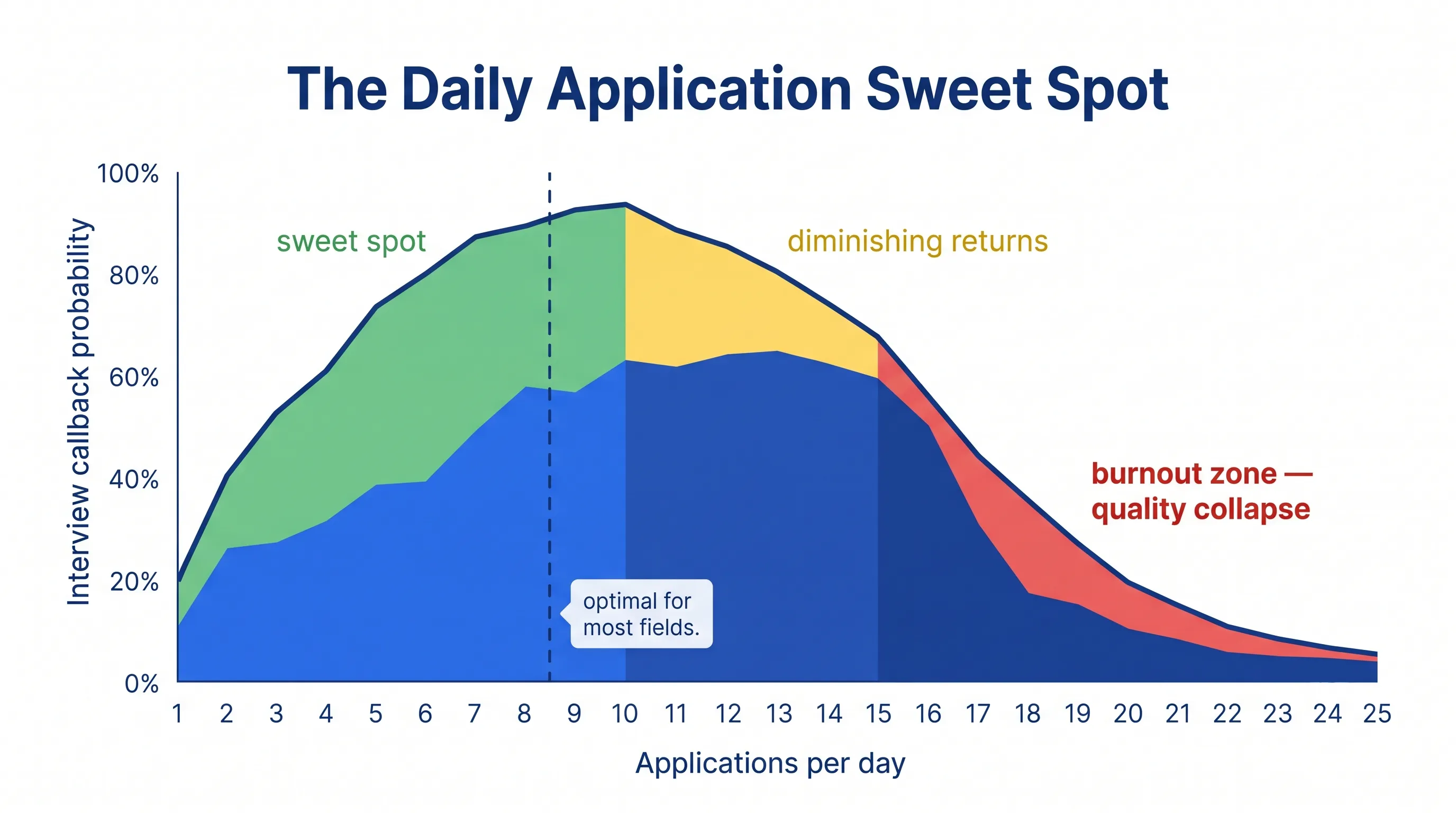
If tailoring takes 15 minutes per submission, doing 10 is 2.5 hours of focused work. Doing 20 is five hours. By #14, you're copy-pasting with typos and the quality of what you're sending drops measurably. Volume goes up; response rate goes down; the result is a bigger pile of silence. The obvious next thought is "then use AI to tailor faster." Before you go there, read whether Claude can actually apply to jobs for you at volume. Short answer: no.
Adjust your daily target based on interview pipeline health
Your daily number is a signal you tune weekly based on what's coming back. Two rules:
- 2 or more active interviews in the pipeline? Cut daily sends in half. You already have irons in the fire; a signed offer in three weeks makes 40 more applications a waste of energy.
- Zero replies after 30–40 sends in your field? Stop applying. The problem lives in the resume, the seniority level, or the roles you're targeting, and more volume won't fix it. See the diagnostic section further down.
Dynamic adjustment is how experienced job seekers keep total sends in the 100–150 range while less strategic ones hit 300+ with fewer offers.
The ghost job tax on your conversion rate
Roughly one in five job postings is a ghost: reposted from months ago, already filled internally, or pipeline-building for a role that doesn't exist yet. Listings also linger long after they go dead. Clarify Capital's research found around 40% can stay up after the role is filled. Recruiting software automates job distribution across boards, and the cleanup rarely follows. So yes, that cover letter you spent 20 minutes tailoring at midnight? The job was filled in March. Nobody's ghosting you specifically. The listing is dead and everyone who applied is in the same silence.
Your effective conversion rate is lower than the benchmarks above. If tech shows ~1.9% on paper, the real number after filtering dead listings is closer to ~1.3–1.5%. Your 156-application target is closer to 200 once you account for the dead ends. Filter your list first.
Practical filters: posted within the last 21 days (fresh postings get 5–10x the response rate of stale ones; most hires close within 30 days of the initial posting), names a specific team or hiring manager, and the company is showing activity on LinkedIn (recent posts, replies to candidates). Skip anything reposted more than twice or sitting on a blanket "we're always hiring" page.
What a realistic daily application schedule looks like
If you're doing it manually, a real day of applying takes about 3 hours for a tech candidate targeting 8 sends. Here's the breakdown:
If you're spending 8 hours a day on this, most of that time is refreshing LinkedIn and re-reading the same three postings. Cut it to 3 hours, get outside. The quality of what you send at hour 7 is measurably worse than at hour 2, and volume alone doesn't compress the 58-day median.
Where JobHire.AI fits in the process
The schedule above is what a manual search looks like: 3 hours per day, 8 tailored sends, and that's if you're disciplined about it. Most people aren't, and the volume drops off at week three or four. That's exactly when it needs to stay consistent, because the 58-day median clock keeps running whether you feel like applying or not.
JobHire.AI was built for this specific problem. It filters ghost jobs automatically, matches keywords from each job description to your resume (the ATS pass), and submits on your behalf. You see every application before it goes out and approve or skip at your discretion. The platform holds the volume consistent across week one and week eight; you show up for the replies.

Best time to apply for jobs: days and hours that convert
Submission timing moves the callback rate more than most people expect: applications sent Tuesday through Thursday, 10–11 AM local time, tend to get a meaningfully higher callback rate than ones sent Friday afternoon or Sunday evening. Recruiters clear their queue early in the week, so a Tuesday-morning application lands near the top of the stack instead of at the bottom of a weekend backlog.
Combine time-of-day with time-since-posting: applications sent within 48–72 hours of a listing going live convert at ~5x the rate of applications sent to a two-week-old listing, because recruiters typically start scheduling first-round screens once they've reviewed the first 20–30 candidates. If your target is 5 per day, send 3 on Tuesday morning to fresh postings and 2 on Wednesday, instead of clearing 5 on Sunday night against week-old listings.
What to do when your applications aren't converting
If you've applied to ~60 roles in your field and gotten zero interviews, the universe is sending you a calendar invite titled "We need to talk about your resume." Adding volume with the same targeting won't fix a positioning problem.
Why the 2026 job market is harder than 2024
Numbers are harder to hit than they were two years ago, and the reason is worth knowing before you chalk the process up to personal failure. Greenhouse's 2026 Hiring Benchmarks analyzed 640M+ records across 6,000+ companies and found candidates per open position hit 244 in 2025, up 111% from 2022. Over the same period, recruiter headcount at those same companies dropped 56%.
More candidates, fewer recruiters. That's why interview conversion sits lower than it did two years ago. CareerPlug's 2025 report puts the 2024 aggregate at 3% and notes it's down from the prior year. The table above reflects that 2024 reality, not the 2021 market.
The formula: (apps per interview for your field) × (target interviews) ÷ (working days of runway) = your daily number.
For most fields, that lands between 1 and 8 per day. If it comes out above 10, you have three options: extend your runway, stop hand-tailoring every single one, or shift the mix toward referrals (one warm intro replaces ~15 cold sends). Use the calculator above, come back for the timing piece for the last 30% of response rate, and close the tab once you have a number you'll actually stick to.
Sources cited in this article
- CareerPlug 2025 Recruiting Metrics Report: 10M+ hiring records, 60K+ US businesses, 2024 data. Source for the 3% aggregate application-to-interview rate.
- Greenhouse 2026 Hiring Benchmarks: 640M+ records across 6,000+ companies. Source for 244 candidates per opening and recruiter headcount trends.
- Huntr Q1 2025 Job Search Trends Report: 635,851 tracked entries from 19,918 seekers. Source for 58-day median offer timeline and weekly send-volume distribution.
- Pin Recruitment Funnel Benchmarks 2026: Confirms 3% aggregate interview rate and senior-role conversion ranges.
- Ashby 2026 Talent Trends Report: 54M+ data points, 93K roles. Cross-validation of funnel conversion stages.
- Clarify Capital: Ghost Jobs Study: Source for post-fill listing persistence (~40%).
- High5Test Job Search Statistics: Source for 72% mental health impact stat.
- The Interview Guys: How Many to Get Hired 2025: Multi-study compilation; source for 32–200+ total sends range.
- StandOut CV: How Long Recruiters Spend on a Resume: Consolidates multiple eye-tracking studies; source for 6–8 second initial scan stat.
- Jobscan: Fortune 500 ATS Usage Report: Source for 97.8% of Fortune 500 companies using an ATS (2025).
- Resume Genius: Cover Letter Statistics: 2023 hiring manager survey. Source for 83% read / 94% influence cover letter stats.
- Zippia: Employee Referral Statistics 2026: Source for 4x hire likelihood for referred candidates vs. cold applicants.