The Best Time to Apply for Jobs: 4.5M Postings Analyzed

The best time to apply for a job is Tuesday morning, submitted between 8 and 10 a.m. Eastern Time so the application lands before recruiters open their 10 a.m. to 1 p.m. ET review block. JobHire's analysis of 4.54 million U.S. job postings and 245,000 interview invitations (July 2025 to May 2026) shows Tuesday is the busiest day for new postings (19.5% of the weekly supply), and Monday is the busiest day for outbound invites, with employers sending roughly 49,400 interview invites - 35% more than on a typical Friday.
We analyzed 4.54 million U.S. job postings and 245,000 interview invitations sent through JobHire over an eleven-month window. The data reveals a sharp weekly rhythm that most career advice gets wrong.
- Tuesday is the busiest day for new jobs. 19.5% of all weekly postings go live on Tuesday, nearly 1 in 5.
- Monday is the busiest day for interview invites. Employers send 49,400 invites on a typical Monday, more than any other day.
- 10 a.m. to 1 p.m. ET is the peak window for interview invites, not the 6-10 a.m. window commonly cited in job advice.
- Friday is silent by design. Friday produces 26% fewer invites than Monday. Weekends drop ~3× lower across both datasets.
- Tuesday-Thursday alone cover 55% of all new postings. Three days carry the working week.
The Best Day to Apply for Jobs: Tuesday
If you want your application to land in the same week as the largest pool of fresh postings, apply on Tuesday. Our analysis of 4.54 million job postings ingested by JobHire between September 2025 and May 2026 shows Tuesday as the consistent weekly peak: 19.5% of all new roles go live that day, more than any other day of the week.
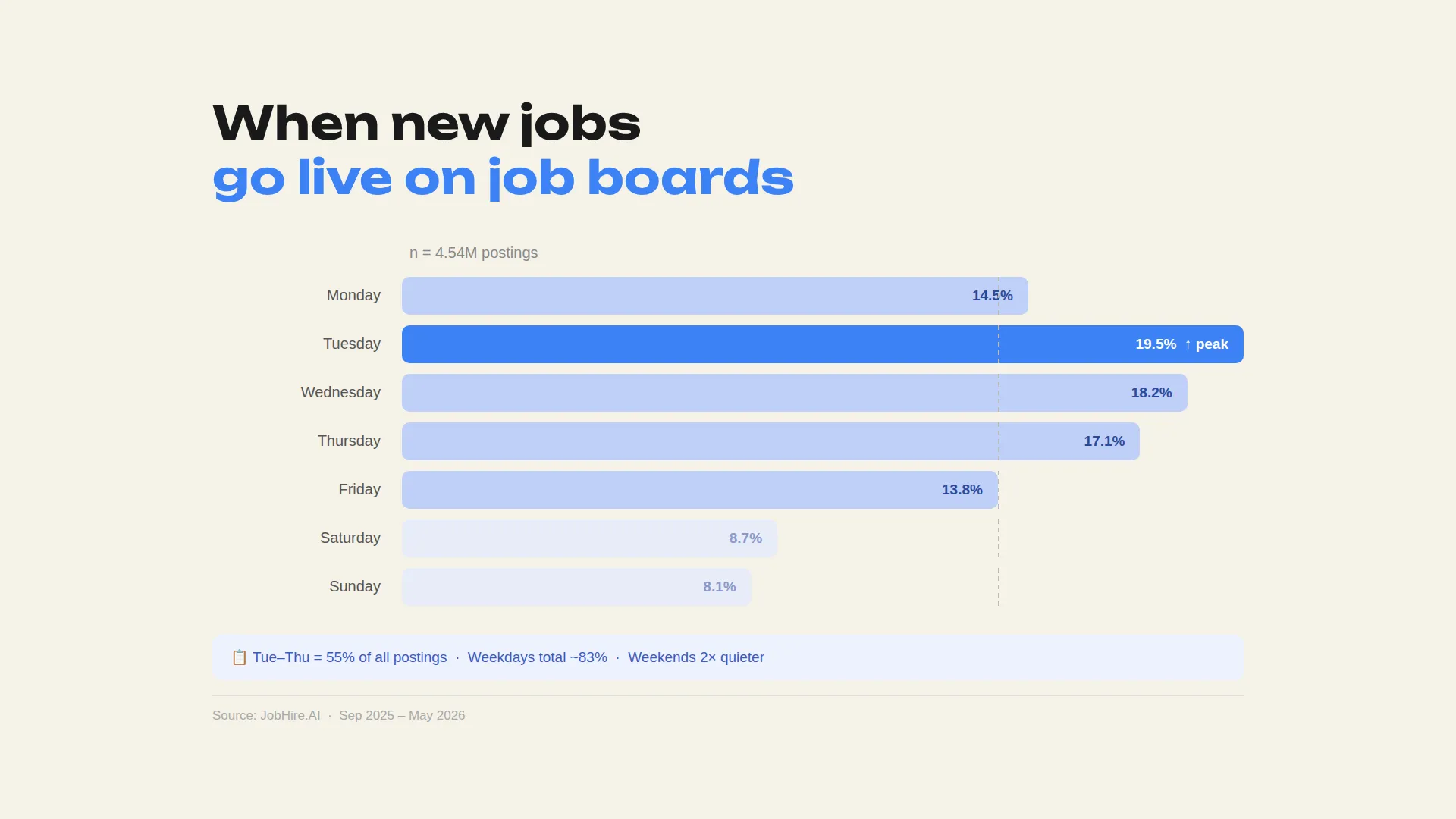
Share of new U.S. job postings by day of week, September 2025 to May 2026. Source: JobHire platform data, n = 4.54 million postings.
| Day | Share of postings | Pattern |
|---|---|---|
| Monday | 14.5% | Ramp-up day |
| Tuesday | 19.5% | Weekly peak |
| Wednesday | 18.2% | Sustained mid-week |
| Thursday | 17.1% | Sustained mid-week |
| Friday | 13.8% | Wind-down |
| Saturday | 8.7% | Weekend trough |
| Sunday | 8.1% | Weekend trough |
Share of new U.S. job postings by day of week. JobHire platform data, September 2025 to May 2026.
Tuesday-Thursday carry 55% of all weekly postings
Three days produce more than half of the supply. If you concentrate your job-search hours between Tuesday morning and Thursday afternoon, you cover the bulk of new roles before the weekend reset.
Why does Tuesday produce the most postings? Hiring managers and recruiters spend Monday clearing the inbox from the weekend, getting alignment from team leads, and reviewing the prior week's pipeline. By Tuesday, requisitions that were drafted in Monday's planning rituals go live. This rhythm explains when new jobs get posted across U.S. employers: postings keep cycling Wednesday and Thursday because each new req triggers internal routing time and external posting approvals.
The Best Time of Day to Apply: 10 a.m. to 1 p.m. ET
Conventional job-search advice often points to early-morning submissions (6-10 a.m.) as optimal, sometimes citing the idea that recruiters review applications first thing. Our data tells a different story for the response side of the funnel.
Across 245,000 interview invitations sent through JobHire between July 2025 and May 2026, the heaviest concentration of invites lands between 10 a.m. and 1 p.m. Eastern Time, not in the 6-10 a.m. window. The pattern matches when recruiters and hiring managers are actively reviewing applications mid-morning, after their first inbox sweep and pipeline check.
Practical implication. Submitting between 8 a.m. and 10 a.m. ET puts your application at the top of the queue when recruiters open it for the 10 a.m. to 1 p.m. review block. Submissions made after 1 p.m. ET often wait until the next morning's review cycle.
When Employers Send Interview Invites
Interview invitations follow a different weekly shape than job postings. On the response side, Monday is the busiest day, with 49,400 invites sent on a typical Monday across the JobHire platform. The cadence drops gradually through the week, hitting a sharp Friday wind-down and a near-silent weekend.
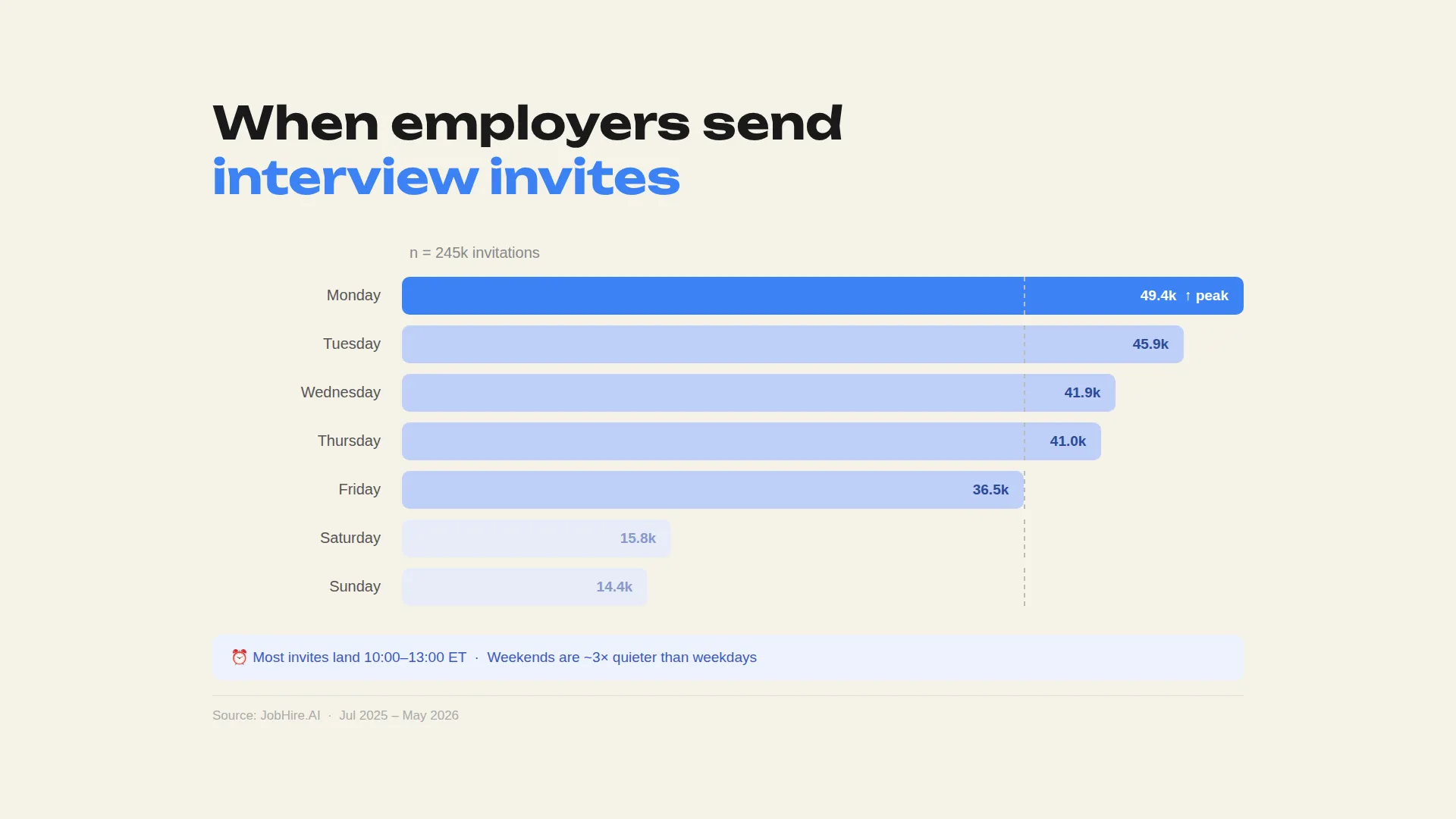
Interview invitations sent by day of week, July 2025 to May 2026. Source: JobHire platform data, n = 245,000 invitations.
| Day | Invitations sent | Pattern |
|---|---|---|
| Monday | 49,400 | Weekly peak |
| Tuesday | 45,900 | High activity |
| Wednesday | 41,900 | Sustained |
| Thursday | 41,000 | Sustained |
| Friday | 36,500 | Wind-down |
| Saturday | 15,800 | Weekend silence |
| Sunday | 14,400 | Weekend silence |
Interview invitations sent by day of week. JobHire platform data, July 2025 to May 2026.
Monday produces 35% more invites than Friday
The drop from Monday's 49.4K to Friday's 36.5K reflects a 26% week-over-day decline. Many recruiters batch outreach early in the week to maximize the chance of getting candidate availability before the weekend. By Friday, the pipeline shifts from invite-sending to interview-conducting and pipeline review.
The Friday Silence Effect
Across both datasets, Friday is consistently slower than the rest of the working week, and weekends are dramatically quieter than any weekday. Saturday and Sunday combined produce only 17% of weekly job postings and 12% of weekly interview invites.
For candidates, this is a useful framing. If you have not heard back on Friday afternoon, the silence almost certainly reflects the recruiter's calendar, not a rejection. The same is true for the entire weekend. Most employers concentrate invite-sending in the Monday-to-Thursday window, with Friday left for interview scheduling and pipeline cleanup.
What This Means for Your Job Search
Three practical tactics emerge from the data:
Concentrate applications between Tuesday morning and Thursday afternoon
Tuesday-Thursday cover 55% of new postings. Applying inside this window puts you in the largest pool of fresh roles before the weekend reset. Applying on Friday afternoon means competing for visibility on a Monday when 49,400 invites are flying out for the prior week's pipeline.
Submit between 8 a.m. and 10 a.m. ET
Land your application before the 10 a.m. to 1 p.m. ET review block. Submissions made after 1 p.m. ET typically wait for the next morning's review cycle, which can cost you 18-22 hours of visibility.
Treat Friday-to-Sunday silence as a calendar artifact
Friday and weekends produce 60-70% fewer invites than Monday. If your inbox is quiet on Friday or over the weekend, do not interpret it as a signal about your candidacy. Monday morning is when the response queue clears.
For active job seekers, the combined pattern points to a tight execution window: prepare resumes and tailoring over the weekend, submit applications Tuesday and Wednesday mornings, and expect the strongest interview response signal to arrive Monday or Tuesday of the following week.
Methodology
About this dataset
- Interview invitations: 245,000 invites sent to candidates on the JobHire platform between July 2025 and May 2026, covering eleven months of continuous activity.
- Job postings: 4,540,000 U.S. job postings ingested by the JobHire platform between September 2025 and May 2026, covering nine months. The posting dataset began later because structured ingestion of posting timestamps was rolled out at platform scale in September 2025.
- Geographic scope: U.S.-based job postings and U.S.-resident candidates.
- Time zone: All hour-of-day analysis is normalized to Eastern Time, which captures the largest share of U.S. recruiter activity.
- Day boundary: A posting or invitation is counted on the day its timestamp falls in Eastern Time, regardless of the candidate's local time zone.
- Exclusions: Duplicate postings reposted by aggregators within 7 days were de-duplicated. Test invitations and internal communications were excluded.
- Sampling: No sampling. All postings and invitations within the date windows were included.
This research is part of an ongoing JobHire research series on U.S. hiring patterns and job-search effectiveness. For methodology questions, dataset access requests, or press inquiries, contact the research team via the JobHire main site.
Citation & primary source
- Primary source: JobHire.AI Research Team, originally announced on LinkedIn (June 2026).
- JobHire.AI Research Team, "The Best Time to Apply for Jobs: 2026 Research Report," published June 27, 2026. Based on JobHire proprietary platform data.
- Interview invitation dataset: 245,000 invitations, July 2025 to May 2026.
- Job posting dataset: 4.54 million U.S. postings, September 2025 to May 2026.
- Press, dataset access, or methodology inquiries: jobhire.ai.