
Career Change at 50: 5 Second Careers That Actually Work

Yes, you can change careers at 50. The real work is deciding what to fix first, because most guides answer "is it too late" and stop there. Three things matter more than any second-career personality test: a resume that doesn't hand a recruiter your age before they read one line of experience, a runway number that respects the fact that you have 10 to 15 working years left instead of 30, and a shortlist of second-career roles that credit two decades of built expertise rather than asking you to start over.
Fifty is the age where the career question changes shape. Twenty-five-plus years of experience. Kids in college or a house nearly paid off. A specific kind of tiredness with a specific kind of job. Talk to enough people who actually pivoted after 50 and one line keeps surfacing, almost verbatim: it's an odd age, too early to retire, too late to start from scratch, and yet here I am doing exactly that.
This piece covers the parts that actually decide whether you get hired at 50: how your resume gets filtered before a human reads it, what the runway math looks like when you also have a retirement horizon and possibly a healthcare gap to bridge, and which of your 25 years of experience actually translates versus which parts to quietly leave off the page. If you're still deciding whether to leave your current job at all, start here. If you're closer to 40 than 50, the same framework in a different setting lives at Career Change at 40.
It's a strange age: too early to retire, too late to start from scratch… and yet here I am doing exactly that. – r/careeradvice
/ 01The real difference between a career change at 30 and at 50
The mechanics of a career change over 50 aren't fundamentally different from one at 30. The weight around the decision is what changes. Retirement sits closer than it did fifteen years ago, the resume reads "senior" by default, and every application carries that specific fear a hiring manager will do the math on your graduation year and quietly move on.
Years on the recruiting side, and one pattern held up: age itself rarely changed my read on a candidate. What changed it was noise. A cover letter apologizing for the pivot. A document trying to argue relevance instead of showing it. A resume that read like a retrospective instead of a pitch. Recruiters aren't running an age-detection script in their heads. They're reacting to how tired the application sounds.
Career change at 50 also gets treated as unusual when it isn't. The Bureau of Labor Statistics tracked Americans born between 1957 and 1964 across their working lives and found the average person held 12.4 jobs by age 54. That number gets misquoted online as "12 careers," which is a bigger claim. Even the accurate version puts a change at 50 well inside the normal range. What people on Reddit describe intuitively (one commenter put it as "I've accepted I'll have to switch jobs every 7 years") the data has been showing quietly for decades.
Not harder mechanically than at 30. The mechanics are identical: fix the resume, budget the runway, pick a role that credits your existing experience. What's heavier is the emotional weight of pivoting after 25+ years of a built-in identity. BLS data on job cycles shows a switch at 50 is well inside the normal range, not the exception.
/ 02The age discrimination problem nobody fixes for career changers at 50
Money isn't the biggest fear at this age. Starting over isn't either. The resume is.
Even after spelling out how my 25 years of experience is transferable, to them I'm nothing more than a newb. AI is scanning applications for keywords, and when it doesn't see a history from that sector, I get binned. – r/careeradvice
Career-change advice usually acknowledges that age bias exists at 50, then pivots to "stay positive." Which costs nothing to say and does nothing for the reader. A few habits on the page quietly signal your age before a hiring manager reads a single accomplishment. Fix the mechanics and half the problem goes away.
Neither your resume nor your LinkedIn "Education" section needs it. It's one of the easiest data points an ATS or a skimming recruiter uses to estimate age, and it adds zero information about whether you can do the job.
Cap it at 12 to 15 years. Older roles rarely help and mostly signal "how long ago" instead of "how qualified." Roll pre-2010 experience into a one-line "Earlier career" note if it matters, or drop it entirely.
"Webmaster" reads as 2008. "Programmer Analyst" reads as 2005. Today's vocabulary for the same jobs is "Digital Producer" and "Software Engineer." ATS keyword matching cares about the words on the page, not your intent. Re-title accordingly.
None of these three fixes erase your age from a resume. A hiring manager can still count career length from your dated jobs, notice which tech stacks you list, or pick up on writing style. What they do is remove the fastest data points, the ones most likely to end a screening pass in under ten seconds.
None of this makes age discrimination legal. The federal Age Discrimination in Employment Act (ADEA), enforced by the EEOC, prohibits age-based bias for workers 40 and older in hiring, firing, promotion, and compensation. What matters practically is the gap between what's legally banned and what actually shows up on debrief calls, which is why the resume-mechanic fixes above matter more day-to-day than the complaint process.
Graduation year wasn't something I consciously hunted for when I was screening resumes. But I'd catch myself doing the math without meaning to, and I watched enough hiring managers do the same thing out loud on debrief calls. The bias is quieter after 50 than before it. Nobody writes "did the math on their age" into an official rejection. It still happens.
The challenge after your mid-forties is ageism. For me, job hunting and interviewing has been very, very different post 50. – r/careerchange
None of this is paranoia. Age discrimination in automated hiring-screening tools is documented enough that we've covered the research separately. Opting out of AI screening mostly just slows you down, so that's not the fix. The fix is making sure the resume that reaches the filter doesn't hand it a reason to guess your age. For the full mechanics of how ATS parses and scores a resume, see How ATS Reads Your Resume.
One variable this section doesn't touch: a real gap in your work history from caregiving, a return after a health event, or an early-retirement attempt that didn't stick. The resume mechanics still apply. What gets added is one line in the cover letter naming the gap directly, then moving on. Leaving it unaddressed usually reads worse than the gap itself. Keep the explanation to a sentence. Anything longer starts sounding like an apology.
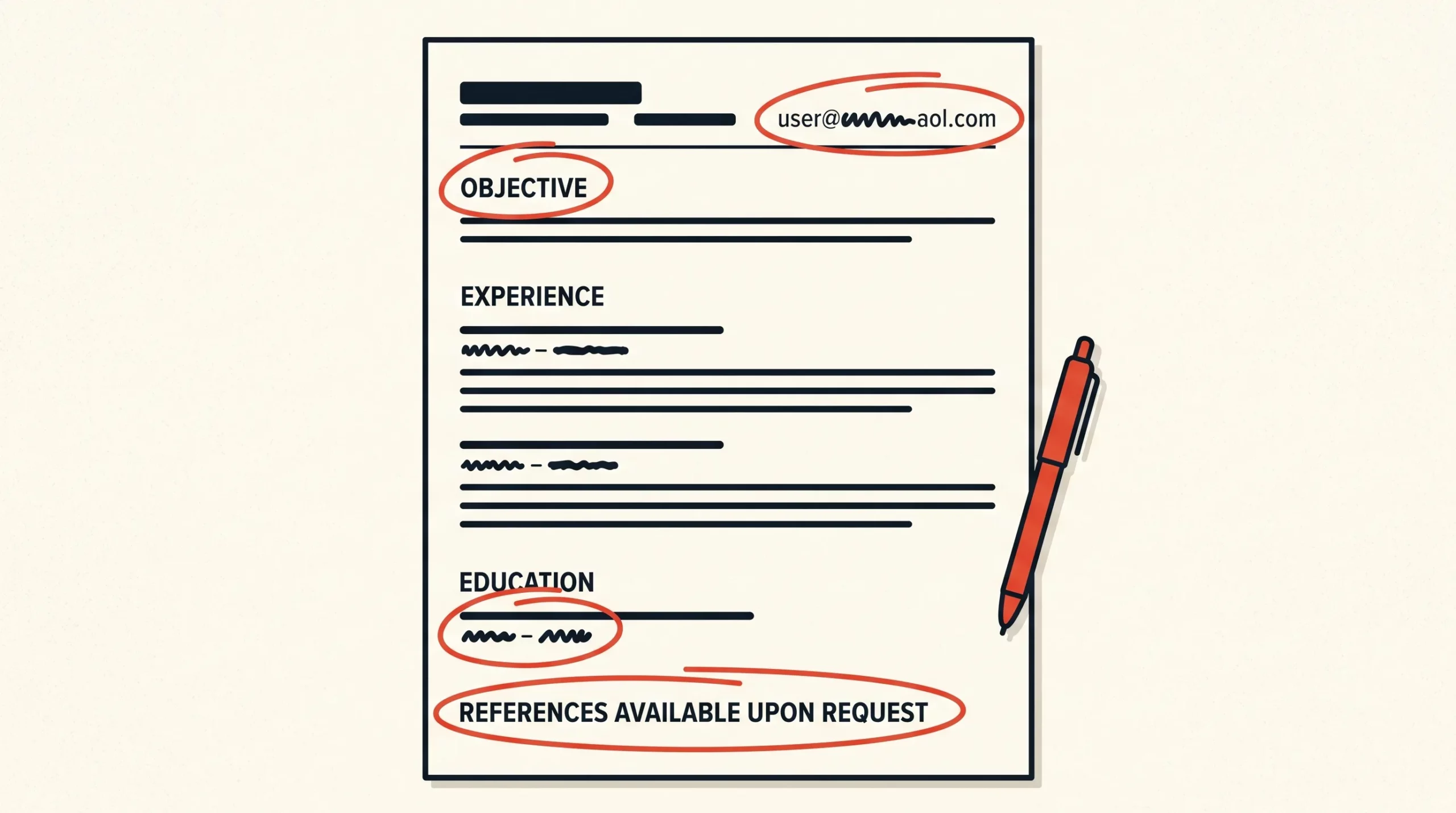
Beyond the age-signaling mechanics above, four less-obvious flags show up on 50+ resumes: an "Objective" section (dated format from the early 2000s), a "References available upon request" line (assumed, adds nothing), dense paragraph blocks instead of scannable bullets, and using an AOL or Hotmail address in the header. Any one of these tells a recruiter your document was last updated a decade ago, which cues them to look for other signals of dated thinking.
/ 03What a career change at 50 actually costs
Cost at 50 isn't just a tuition line item. It's a compound question that sits alongside three things a school's fee sheet doesn't show: how many working years remain to earn tuition back, whether leaving your current job strips employer health coverage before Medicare kicks in at 65, and whether the timing collides with a partner's retirement plan or a kid still finishing college.
Price It Locally Before You Budget
A single community college class can run anywhere from roughly $300 to $900+ depending on the state and school: a 3x spread for identical coursework. National averages are close to useless here. Call your local school directly before you build a budget around someone else's number.
A graduate degree or MBA at 50 is the highest-cost, highest-risk route. Run the ROI math (projected salary bump against tuition, lost income, and how many working years remain to earn it back) before enrolling, not after. A focused certification or short program is almost always the cheaper, faster route into an adjacent field. Avoid pulling from retirement accounts to fund tuition without talking to a fee-only financial advisor first. The tax hit and the compounding-loss cost are often larger than the tuition itself.
Separately from tuition, budget your job-search runway. From the recruiting side I saw this play out consistently: for a career change at 50, plan for roughly two-and-a-half times the timeline of a same-field search at 30. If a lateral move typically runs three to five months, a pivot into a new field at 50 more often lands in the nine-to-fifteen range. Two things add to the base timeline: fewer companies filter on age-friendly signals, and hiring managers spend longer verifying that transferable skills actually transfer at senior compensation bands. For the base rate on lateral moves, see the median search timeline.
What kind of jobs won't take a toll on your body and mental health until you retire? – r/careerguidance
The runway framing that matters at 50 and didn't at 30 is health, not just money. The average over-50 commenter on career-change threads isn't asking "what pays best." They're asking what won't wreck them physically or mentally, and what will still leave enough work-life balance to enjoy the years before they reach retirement. That's a legitimate filter, and it should sit in your role-selection process at the same weight as income. A high-comp role that costs you five years of health at 55 is a bad trade in a way it wasn't at 30.
Prioritize entry paths under $2K and under six months. CDL certification, medical billing and coding, real estate licenses, and administrative certificates all fit. Government roles through USAJOBs.gov and non-profit sector positions hire older workers more consistently than corporate, and federal benefits vest after 5 years. Small local businesses value life experience in ways enterprise job boards don't advertise.
/ 04How your experience becomes leverage in a career change at 50
The instinct heading into a second career at 50 is to downplay your experience so you don't look "overqualified" or expensive. For most second careers the right move runs in the opposite direction. The goal is to reframe what you've built into something the new field recognizes, not to hide it.
Twenty-five years of coordinating people. Managing budgets. Reading a room. Sitting through a bad quarter without panicking. Knowing when to escalate and when to absorb. These transfer directly into almost any new field, and most people at 50 are bad at naming them on paper because they sound obvious to someone who's had them for two decades. Spell them out anyway. A hiring manager evaluating a career-changer at 50 is specifically looking for evidence that you can operate at a senior level in an unfamiliar domain without needing to be managed.
A career change at 50 isn't too late. It just feels heavier because you've built a life around your old work. The people who handle it best treat it as a pivot, not a reset. – r/careeradvice
The other thing that changes at 50: the shape of a good target role is different than at 30. Instead of climbing a new corporate ladder from the bottom, the fastest landings for 50+ are roles that either monetize your existing decades (consulting, coaching), give you schedule and geographic control (real estate, skilled trades), or plug into sectors where older workers are actively preferred (non-profit, government, small business). Remote work sits alongside these as a fourth category worth naming separately, because it expands your hiring pool beyond local commute range and skips the office-culture-fit hurdle that quietly filters older candidates.

Where those transferable skills tend to land for a second career at 50+, with the credential most commonly asked for and a rough timeline from starting the cert to a first role in the field:
| Target role | What transfers from your current career | Entry credential | Time to first role |
|---|---|---|---|
| Consulting / Coaching | 20+ years of domain expertise, ability to advise senior stakeholders, network | Portfolio + LinkedIn presence | 2–4 mo |
| Non-profit / gov PM | Coordinating people, timelines, budgets, comfort inside a regulated process | CAPM or PMP | 3–6 mo |
| Real estate agent | People skills, local network, comfort managing your own schedule | State license (varies) | 2–4 mo |
| Healthcare admin | Scheduling, documentation, working inside a compliance-heavy environment | Medical billing / coding cert | 6–12 mo |
| Skilled trade / CDL | Independence, physical alternative to desk work, direct value delivery | CDL Class A or trade apprenticeship | 1–3 mo (CDL) |
Timelines assume part-time preparation alongside a current job, not a full-time sprint.
This is the shortlist, picked for how consistently these roles credit the experience you've already built rather than asking you to start over. Most of these paths also work as a career change at 50 without a degree, or for someone with no experience in the target field, because they hire on demonstrated skill plus a short credential rather than a matching job title. Several of these paths (real estate, non-profit PM, healthcare admin) also lean on on-the-job training after hire, which shortens the pre-hire prep window even further. One channel most job-search advice underweights for over-50 candidates: small local businesses often value life experience in ways big-board postings don't advertise. A trucking company, a family-owned real estate office, or a regional nonprofit will read a 25-year work history as an asset. A tech unicorn's ATS reads it as a filter to trip.
The best is whichever role your decades translate into fastest. For most 50+ career-changers: consulting or coaching (monetize 20+ years of domain), non-profit or government project management, real estate, healthcare admin, or a skilled trade with independence like CDL. "Best" rarely means "highest paying" at 50. It usually means the shortest distance from what you already know.
/ 05From decision to interviews after a career change at 50
Career-change advice tends to stop at "make a plan." Our research on application volume puts the overall interview conversion rate around one interview per roughly 33 applications, with senior-leaning roles converting slower than that average. A career change at 50 usually sits well below the senior-role average, because you're competing against candidates with direct in-industry experience and against a hiring instinct that reads a 50-year-old career-changer as a bigger unknown.
Volume alone won't save a career change at 50. Tailoring matters more here than at any other age, because your application has to do the work of translating your transferable skills before the recruiter takes the leap. Run each application against the target job description, check it clears the keyword-match bar covered in How ATS Reads Your Resume, and don't burn your weekly application budget on one long-shot posting.
One channel that works better at 50 than cold applications: informational interviews. A 15-minute ask to hear how someone already doing your target role got there gets returned at a much higher rate than a submitted resume, and produces a warm connection that skips the ATS entirely. Two to three of these a week does more for a career change at 50 than another twenty cold applications.
The rejections that stuck with me were the 50+ career-changers with genuinely transferable backgrounds who applied with materials clearly built for their old field. I'd read three lines, recognize the shape of a different job, and move on. The tailoring gap kills these applications before a human really weighs in. Not the pivot itself, not the age. The document.
Consulting or coaching lands fastest if you already have a portfolio and a network to reactivate (often within weeks). Behind that, a CDL Class A license takes one to three months, and a state real estate license lands in the two-to-four-month range. Anything requiring a formal certificate program (medical coding, PMP) will typically run six months or more before a first paycheck. Fast entry is almost always a trade-off on either salary or corporate stability.
In this order: rewrite the resume for age-neutrality first (drop the graduation year, cap history at 12–15 years, update decade-old job titles). Then budget 9–15 months of runway rather than the 3–5 that works for a lateral move in your current field. Then pick a target role that credits your existing decades: consulting or coaching, non-profit or government project management, real estate, healthcare admin, or a skilled trade like CDL. Then tailor each application to the specific job description rather than relying on volume alone.
Your next chapter starts with knowing
what's actually working against you.
Before you send another application, see how yours reads to the ATS filter between you and a human recruiter. Free, no signup.
Analyze my resume →