14 Top Hiring Companies in U.S. Public Utilities

How many jobs are available in public utilities? Roughly 1.4 million Americans work in the broader U.S. utilities industry in 2024, with about 530,000 in the narrower BLS Utilities sector (NAICS 22).
- The 14 biggest U.S. utilities employ over 230,000 people. Southern Company, PG&E, and Duke Energy lead by headcount.
- Salaries span $49K (meter readers) to $112K (electrical engineers). Linemen earn $93K median.
- Utilities pay ~43% above the national average ($100,272 vs $69,878 nationwide).
- Employment grew 2.7% YoY in 2025; renewable power generation ranks among BLS's fastest-growing industries through 2034.
Public Utilities Employment Snapshot
The U.S. utilities workforce splits across three main areas: electric power generation, transmission and distribution (NAICS 2211), natural gas distribution (NAICS 2212), and water, sewage and other systems (NAICS 2213). Electric power is by far the largest of the three.
Growth is uneven across roles. The BLS 2024–2034 projections list renewable power generation among the four fastest-growing industries in the country, driven mostly by data center demand. Forecasted U.S. data center electricity load is set to triple from ~25 GW in 2024 to about 80 GW by 2030, which translates into thousands of new utility-side hires for line work, plant operation, and grid engineering.
Three concentration facts worth knowing before you target a role:
- Geographic. California (147,000 utility workers), Texas (144,000), and Florida (82,500) lead by state in 2024.
- Demographic. The sector is 77% male, 23% female, by far the most male-skewed of the major regulated industries.
- Pay. Average annual wage of $100,272 makes utilities one of the highest-paying non-tech sectors in the country.
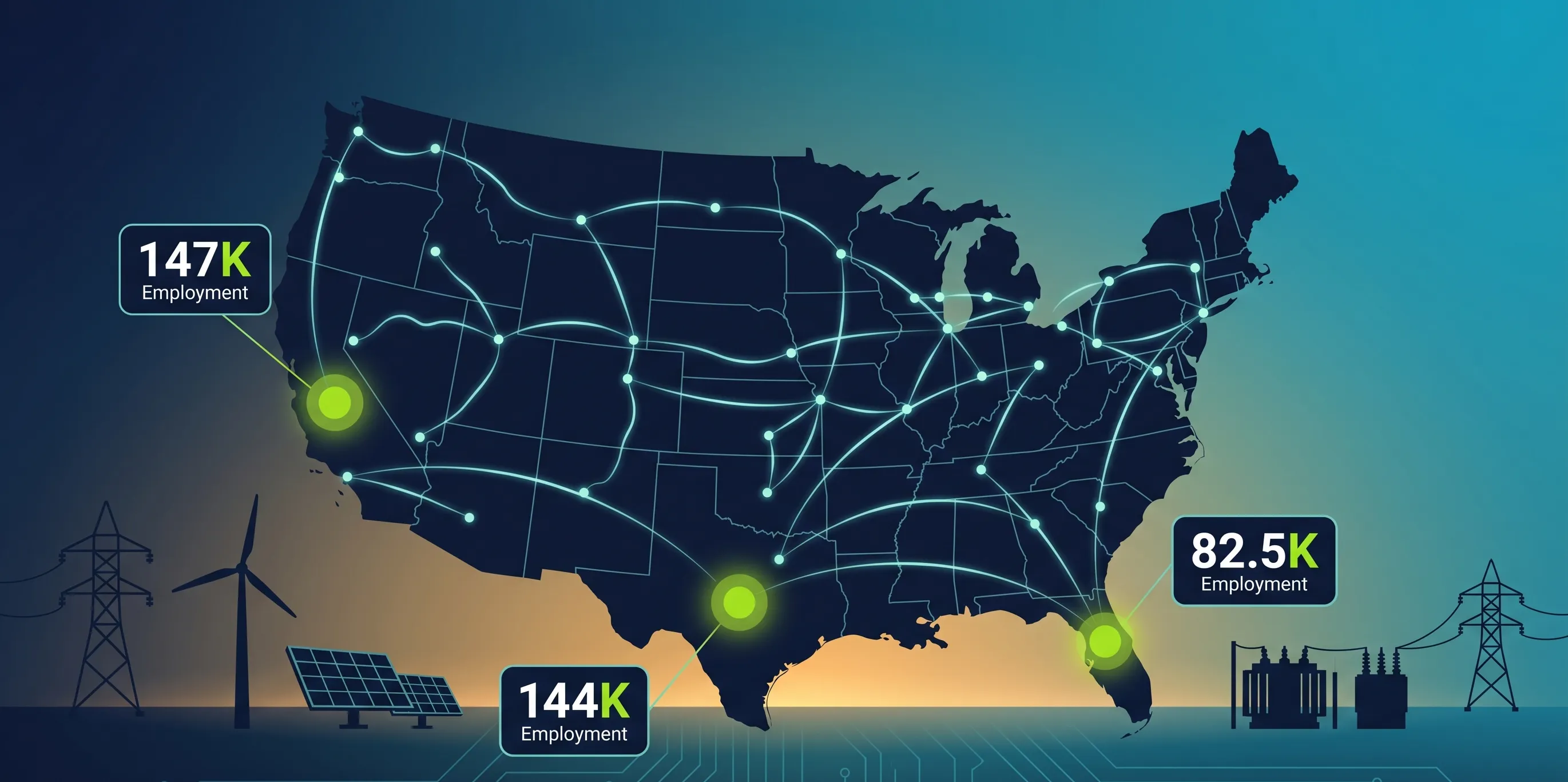
California, Texas, and Florida lead U.S. utility employment in 2024. Data: DataUSA from BLS / Census ACS.
14 Top Hiring Companies in U.S. Public Utilities
The list below ranks investor-owned public utilities by employee headcount in their FY2024 10-K filings (fiscal year ending December 31, 2024). Together these fourteen companies employ over 230,000 people and account for the bulk of regulated electric, gas, and water service in the United States.
1. Southern Company
The largest U.S. investor-owned utility by headcount, Southern Company serves nine million customers across Alabama, Georgia, and Mississippi. The 2024 10-K breaks the workforce down: Georgia Power 6,800, Alabama Power 6,200, Southern Company Gas 4,900, Southern Nuclear 3,700. Active hiring across nuclear operations, transmission engineering, and gas distribution.
2. PG&E Corporation
Pacific Gas and Electric serves 16 million people across northern and central California, the largest single-state customer base in U.S. utilities. Headcount grew 1.4% in 2024 as the company expanded wildfire mitigation, underground line work, and grid modernization. High volume of line worker, vegetation management, and electrical engineering openings.
3. Duke Energy
Serves 8.4 million electric customers across the Carolinas, Florida, Indiana, Ohio, and Kentucky. The 2024 10-K shows headcount down ~600 from 2023, reflecting completed nuclear modernization projects. Steady hiring continues in renewable generation (solar buildout in Florida) and grid resilience.
4. Exelon
The largest regulated transmission-and-distribution utility in the country, Exelon runs ComEd, PECO, BGE, Pepco, Delmarva, and Atlantic City Electric. Headcount is concentrated in line work, substation engineering, and customer operations. No generation business since the 2022 Constellation spin-off, so hiring skews toward grid and metering.
5. Sempra
Operates San Diego Gas & Electric and Southern California Gas, plus a major LNG infrastructure business through Sempra Infrastructure. Significant Texas presence via Oncor. 2024 hiring focused on natural gas distribution, LNG export terminal staffing, and electric grid investments tied to California's renewable mandates.
6. NextEra Energy
Operates Florida Power & Light alongside NextEra Energy Resources, the largest U.S. wind and solar generator. The combined business gives NextEra a workforce split between regulated retail utility roles in Florida and renewable project development across 49 states. Heavy demand for renewable energy engineers, solar field technicians, and battery storage specialists.
7. American Electric Power (AEP)
Serves 5.6 million customers across 11 states with the largest electricity transmission system in the country (40,000 miles of lines). Headcount declined 5.3% in 2024 as the company finished restructuring its retail business. Open roles concentrated in transmission line construction, substation work, and IT/OT cybersecurity.
8. Consolidated Edison
Powers New York City and Westchester County across electric, gas, and steam systems. Con Edison added 505 employees in 2024 (3.5% growth) as the company accelerated grid hardening after Tropical Storm Ida and pushed building electrification ahead of NYC's Local Law 97 carbon caps. Strong union representation, IBEW Local 1-2 covers most field staff.
9. Dominion Energy
Serves 7 million customers across Virginia, North Carolina, and South Carolina. Headcount dropped significantly in 2024 after the divestiture of three natural gas distribution businesses to Enbridge. Hiring is now focused on the Coastal Virginia Offshore Wind project (the largest offshore wind farm under construction in the U.S.) and on supporting data center load growth in Northern Virginia.
10. Public Service Enterprise Group (PSEG)
Operates PSE&G, New Jersey's largest electric and gas utility, plus a nuclear generation fleet. Active hiring in distribution operations, gas infrastructure replacement (the multi-decade GSMP program), and the Salem-Hope Creek nuclear complex. Strong apprenticeship pipeline through IBEW Local 94.
11. FirstEnergy
Serves 6 million customers across Ohio, Pennsylvania, New Jersey, West Virginia, and Maryland through ten regulated distribution utilities. All employees are U.S.-based per the 2024 10-K. Heaviest hiring in transmission line construction tied to the $26 billion "Energize365" five-year grid modernization plan.
12. Entergy
Operates regulated electric utilities in Arkansas, Louisiana, Mississippi, and Texas, plus a 30 GW generation fleet that includes the South's largest nuclear capacity. 2024 hiring focused on transmission expansion to serve new data center and industrial loads along the Gulf Coast.
13. Xcel Energy
Serves 3.7 million electric and 2.1 million gas customers across Minnesota, Colorado, Wisconsin, New Mexico, Texas, Michigan, North Dakota, and South Dakota. Xcel is one of the most aggressive U.S. utilities on renewables and aims for 100% carbon-free electricity by 2050. Open roles span wind project development, transmission, and field operations.
14. Vistra
Operates the largest competitive power generation fleet in the U.S. with 41 GW of capacity across natural gas, nuclear (the 2024 Energy Harbor acquisition), coal, solar, and battery storage. About 1,940 employees are covered by collective bargaining agreements. Strong hiring tied to nuclear plant operations and grid-scale battery deployment.
How to read this list. Headcount comes directly from each company's FY2024 Annual Report on Form 10-K filed with the SEC. Sempra and PSEG show small discrepancies across public data aggregators depending on whether subsidiary contractors and overseas staff are included. We used the figures reported in the parent 10-K. See sources at the bottom of this article.
Best Paying Jobs in Public Utilities
Pay in utilities skews well above the national average because the work is regulated, often hazardous, and concentrated in union-organized shops. The table below ranks the highest-paying utility roles using May 2024 BLS Occupational Employment and Wage Statistics (the most recent release).
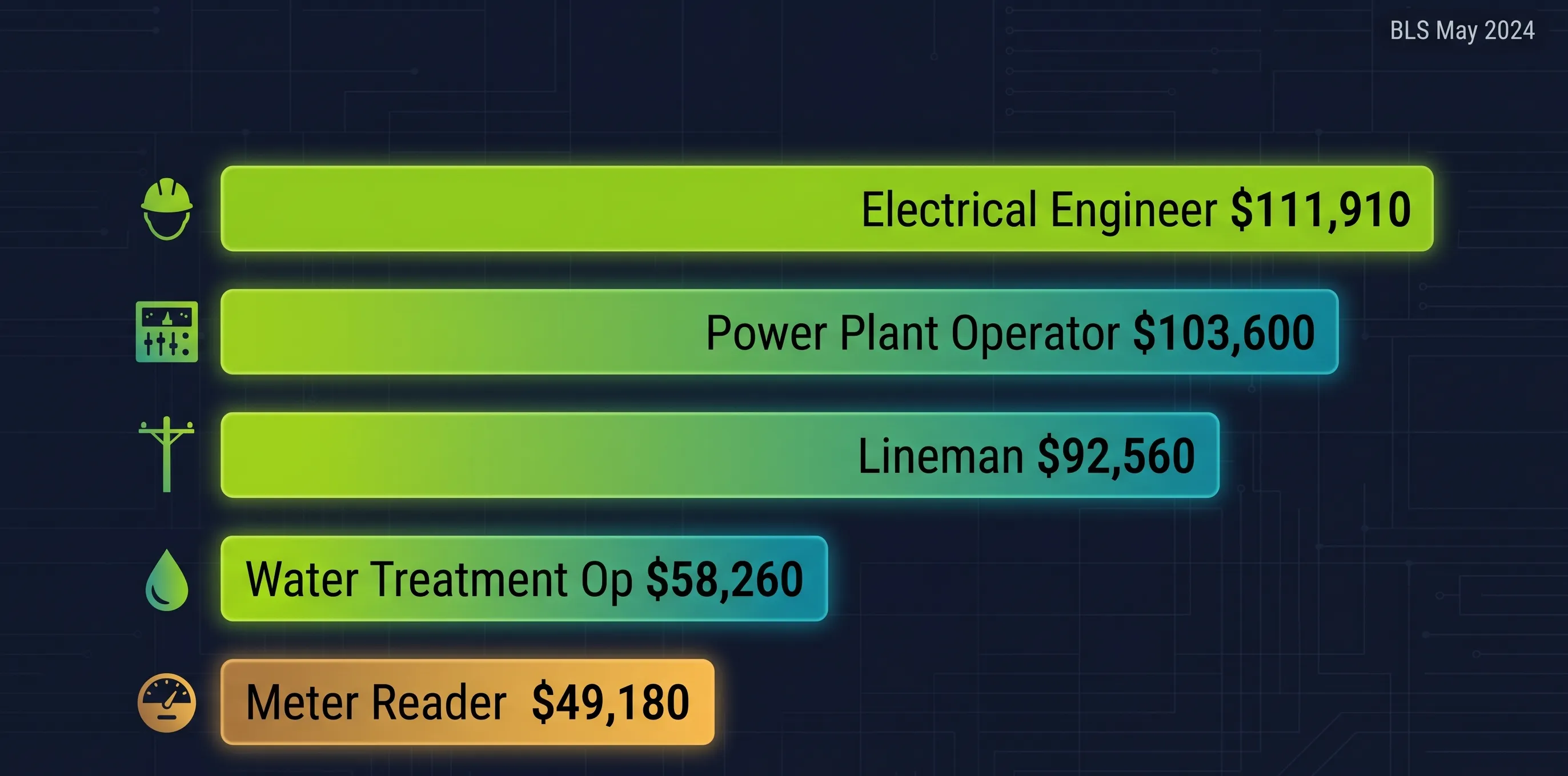
Median annual wages for the five highest-paying public utility roles. Source: BLS Occupational Employment and Wage Statistics, May 2024.
| Role | Median annual wage | Employed (U.S.) | Growth 2024–34 |
|---|---|---|---|
| Electrical Engineer (utility-side) | $111,910 | ~330,000 | +7% |
| Power Plant Operator, Distributor & Dispatcher | $103,600 | 46,600 | Stable |
| Electrical Power-Line Installer / Lineman | $92,560 | ~108,225 | +7% |
| Water & Wastewater Treatment Plant Operator | $58,260 | ~86,890 | −7% |
| Meter Reader, Utilities | ~$49,180 | ~33,000 | Declining |
Median wages from BLS OEWS, May 2024. Growth projections from BLS Employment Projections, 2024–2034.
Why linemen and dispatchers earn six figures
Three structural reasons. Apprenticeship gates: an IBEW or NJATC lineman apprenticeship runs 7,000+ on-the-job hours plus classroom training before journeyman status. Shift work: most plant operators run rotating 12-hour shifts including nights, weekends, and storm callouts. Risk: line work is consistently ranked in the top ten most dangerous U.S. occupations by BLS fatal injury rate. Utilities pay premiums to staff these roles reliably.
Where pay drops
Meter reading is the clearest example of a utility role on the wrong side of automation. Smart meter rollouts have cut the headcount steadily for fifteen years and BLS classifies the occupation as declining. Water treatment operators face a softer version of the same dynamic, with projected −7% employment through 2034 as smaller municipal systems consolidate.
Is Public Utilities a Good Career Path?
Utilities are a stable career bet by most measures: regulated revenue, slow workforce turnover, strong union representation, defined-benefit pensions at many companies (still uncommon outside utilities and government). The catch is what you trade for that stability.
✔ What works
- Average pay of ~$100K runs 43% above the national workforce average.
- Pension plans, union health coverage, and tuition reimbursement remain common at large investor-owned utilities.
- Apprenticeship paths into line work and plant operations need only a high school diploma to enter.
- Recession-resilient. Electricity and water demand stay roughly flat through downturns.
- Heavy hiring tailwind from data center load growth and grid modernization through 2034.
✖ What doesn't
- Shift work, on-call rotations, and storm response are mandatory in field roles.
- Slower tech adoption compared to private-sector engineering jobs.
- Geographic limits. Most roles are tied to specific service territories with limited remote flexibility.
- Promotion ladders are linear and tenure-based at most union shops.
- Public scrutiny is high after outages, rate cases, or safety incidents.
The career suits people who value compensation stability, defined ladders, and structured training over rapid pay jumps. If you want to be promoted to senior engineer in three years on a startup track, utilities will frustrate you. If you want a $90,000 trade job that still has pensions in 2026, line work at any of the fourteen companies above is one of the strongest entry points in the country.
How to Land a Public Utilities Job Faster
Two facts make utilities hiring different from most sectors. First, almost all of the fourteen companies above route applications through major Applicant Tracking Systems (Workday for Duke, NextEra, PG&E, Sempra; SuccessFactors for Southern, Exelon; Oracle HCM for AEP, FirstEnergy). Generic resumes get filtered before a human sees them. Second, openings cluster by season: storm response and apprenticeship cohorts open in spring, plant operator postings concentrate after fiscal-year planning in Q1.
Three practical steps:
- Tailor your resume per role for the ATS. Match the specific NERC standards, OSHA certifications, or apprenticeship designations the job description names. 99 of the top 100 Fortune 500 companies hire through an ATS, and utilities are no exception.
- Get the credentials that gate apprenticeships. CDL Class A for line work in most states, OSHA 10/30 for field roles, a passing score on the EEI Plant Operator Selection System for plant jobs.
- Apply at volume during the right months. Spring apprenticeship windows fill within weeks; missing them costs you a year.
Sources
- BLS Occupational Employment and Wage Statistics, May 2024 release (bls.gov/oes)
- BLS Occupational Outlook Handbook 2024–2034 projections (bls.gov/ooh)
- BLS Industries at a Glance, NAICS 22 Utilities (bls.gov/iag/tgs/iag22.htm)
- DataUSA Utilities Industry Profile, 2024 (datausa.io/profile/naics/utilities)
- SEC EDGAR Form 10-K filings, fiscal year ended December 31, 2024, for Southern Company (SO), PG&E (PCG), Duke Energy (DUK), Exelon (EXC), Sempra (SRE), NextEra (NEE), American Electric Power (AEP), Consolidated Edison (ED), Dominion (D), PSEG (PEG), FirstEnergy (FE), Entergy (ETR), Xcel Energy (XEL), Vistra (VST).