What Is OTE in Sales? Meaning, Math, and the Catch

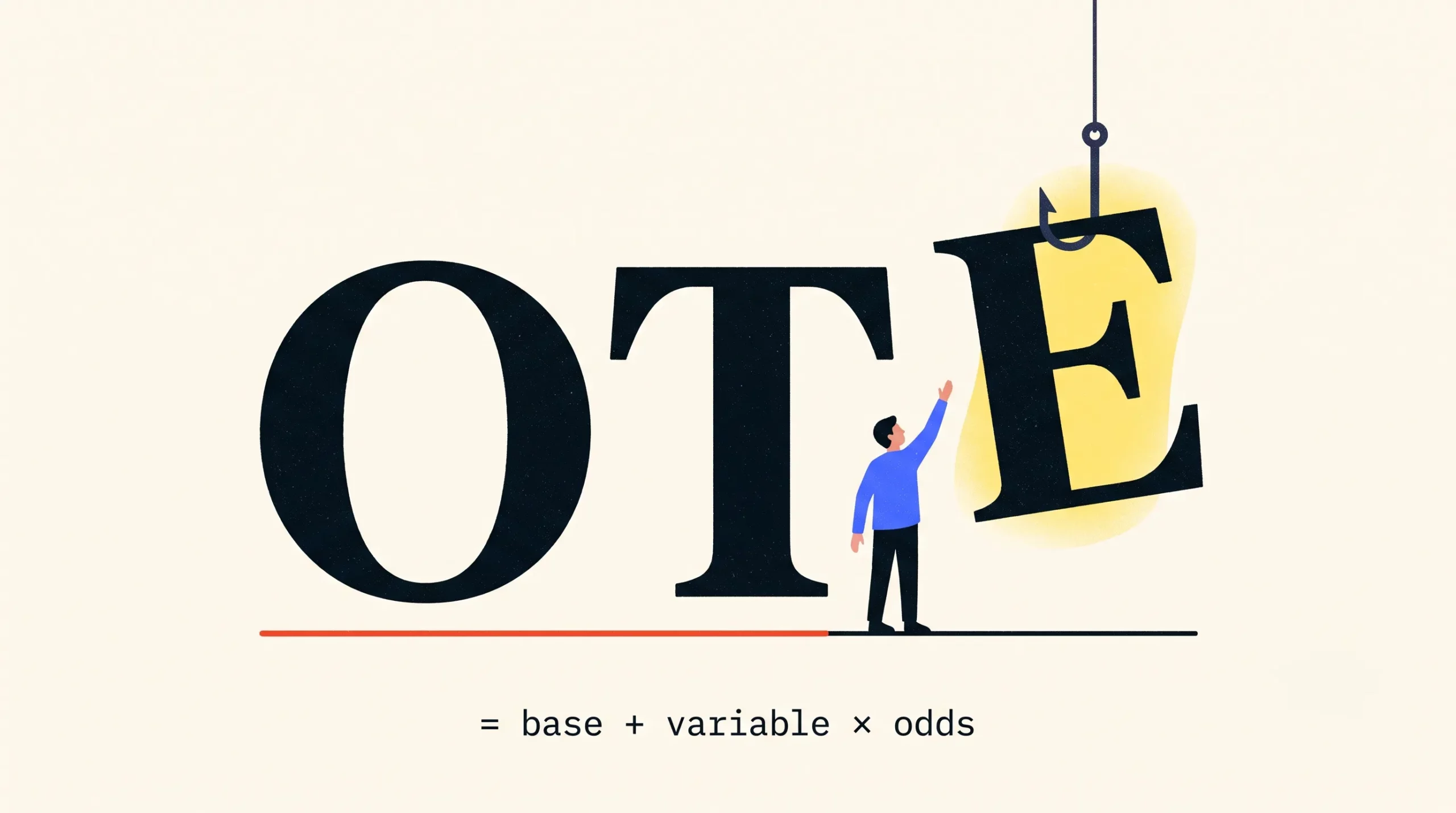
OTE stands for on-target earnings: your base salary plus the variable pay you'd collect at exactly 100% of quota. A $75,000 base with $75,000 in commission at full attainment is a $150,000 OTE. The catch: in cloud sales, fewer than half of reps have hit quota in any quarter since 2024, so treat the number as a claim that needs verification, not a salary.
Every recruiter will give you the formula. What they leave out: the number is a projection built on one assumption, that you'll hit your quota.
Experienced reps price that assumption before they sign. This page shows the definition, the math they run on top of it, and the questions that turn an advertised number into an expected one.
/ 01The definition and the split behind it
The base-to-variable split depends on the role. Closing roles run close to 50/50; a typical Account Executive package is around $100k base / $190k OTE. SDR packages lean heavier on salary, roughly 70/30 ($60k / $85k), because activity targets are easier to hit than revenue targets.
Two mechanics change what the headline number is worth:
Accelerators: higher commission rates above 100% of plan. This is what sales teams mean by an uncapped OTE, top performers who blow past target keep earning. Top AEs clear $400k+ against a $190k package.
Caps and clawbacks: a capped plan turns the target into your ceiling instead. A clawback means paid commission can be taken back. Both quietly rewrite the offer letter.
One more distinction worth knowing: postings usually quote the fully-ramped OTE, what you earn once you're up to speed, typically 3–9 months in. Your realistic first-year number is lower. If a posting doesn't say which one you're looking at, assume it's the bigger, later one.
If a plan is capped, the word "target" is doing a lot of work. Ask which one you're getting before you compare offers.
/ 02How reps actually use the term
In sales job postings, OTE reads like a promise. On sales floors, it's shorthand for a bet, and reps talk about it that way: "the E is out of reach," "it exists only on paper."
The OTE is great but if you can't attain it then it doesn't matter. Company review, RepVue
OTE very far off from actual pay. Another company review, RepVue
Reps earned that skepticism. The two things that decide whether the number is real, team attainment and territory quality, almost never appear in the posting. Which is exactly why they ask about those first. A gap between advertised and real OTE is also one of the most common reasons reps quit inside a year, sales communities even have a name for the pattern: FauxTE.
/ 03Price an OTE like a rep: multiply by the odds
For the odds, use the team's hit rate. Across cloud sales, quota attainment has been stuck between 42% and 44% for nine straight quarters (44.2% in Q1 2026, per RepVue's Cloud Index). Run two offers through the formula and the bigger one can lose:
| Offer | OTE | Base + variable | Team hit rate | Expected earnings |
|---|---|---|---|---|
| A | $190k | $100k + $90k | 60% | ≈ $154k |
| B | $220k | $110k + $110k | 35% | ≈ $148k |
The extreme case is real: one company on RepVue's high-pay list advertised $380k on-target earnings with 10% attainment. Probability-adjusted, the richest offer in the category is a lottery ticket.
OTE calculator: what your offer is actually worth
Plug in the numbers from your offer letter. The default hit rate is the market average; replace it with the team's real figure as soon as you get it.
/ 04OTE by role: what the market pays
RepVue medians for US tech sales roles, plus the column that actually decides your income: the odds. OTE shows up most in closing and account-management roles, but recruiting and customer-success teams increasingly use the same base-plus-variable structure for performance bonuses. The math below applies just as well there.
| Role | Base | OTE | Top earners | Quota attainment |
|---|---|---|---|---|
| SDR | $60k | $85k | $128k | 56% |
| SMB AE | $70k | $132k | $271k | 44% |
| Mid-market AE | $90k | $175k | $391k | 43% |
| Enterprise AE | $135k | $265k | $629k | 40% |
| Account Manager | $100k | $180k | $408k | 49% |
| CSM | $100k | $130k | $227k | 62% |
| Sales Engineer | $145k | $200k | $327k | 56% |
| Sales Manager | $150k | $280k | $511k | 51% |
Read the pattern: the higher the target, the lower the odds of collecting it. Roles with team-linked or activity-based goals (CSM, Sales Engineer, SDR) hit far more often than closing roles. A $130k CSM package at 62% beats a $175k AE package at 43% on expected value, with less variance.
/ 05How to verify the number before you sign
Seven questions that turn a claimed OTE into an expected one:
- What percentage of the team hit quota in the last four quarters? The single best predictor of your "E."
- Why is this territory open? Growth headcount and a predecessor who quit over a poisoned patch look identical in the posting.
- Did the comp plan change in the past year, and how? Annual target raises and payout cuts are the quiet way earnings erode.
- What did your actual top earner make last year? Tests both the upside and whether accelerators are real.
- What share of pipeline is self-sourced? A plan built on inbound that "slowed to a trickle" is a different job.
- How long is ramp, and what's quota during it? Full quota from month one means the first-year number is fiction. Get the ramp timeline in writing.
- How long has the hiring manager been in the seat? Managers control territory allocation, forecast protection and your PIP risk. If they're new, the person selling you the plan may not own it by the end of your ramp.
A specific attainment figure is a good sign. A dodge is data too.
The posting is marketing. The comp letter is the contract. Read the letter.
If guaranteed pay runs out before you can realistically produce, the gap comes out of your income.
/ 06Related terms
- Quota attainment
- The percentage of quota a rep (or team) actually hits. The single number that turns an advertised OTE into an expected income.
- Accelerator
- A higher commission rate that kicks in above 100% of quota. The mechanism behind "uncapped" upside.
- Commission cap
- A ceiling on variable pay. A capped plan turns OTE from a midpoint into a maximum.
- Clawback
- A rule that lets the company take back paid commission, for example when a customer churns early.
- Draw against commission
- Guaranteed pay advanced against future commissions, usually during ramp. Check when it expires.
- Fully-ramped OTE
- What a rep earns once fully up to speed, typically 3–9 months in. Often quoted instead of the lower first-year number.
- Comp-split
- The ratio between base salary and commission, for example 50/50 or 70/30. A heavily base-weighted split is a common red flag.
An OTE you can't verify is a hypothesis.
If the math at your current job stopped adding up, that's usually the moment to start building career pipeline, ideally before you need it.
Start the match →