Workday Powers 38% of Fortune 500 Top 100, Not the 54%+ Commonly Cited

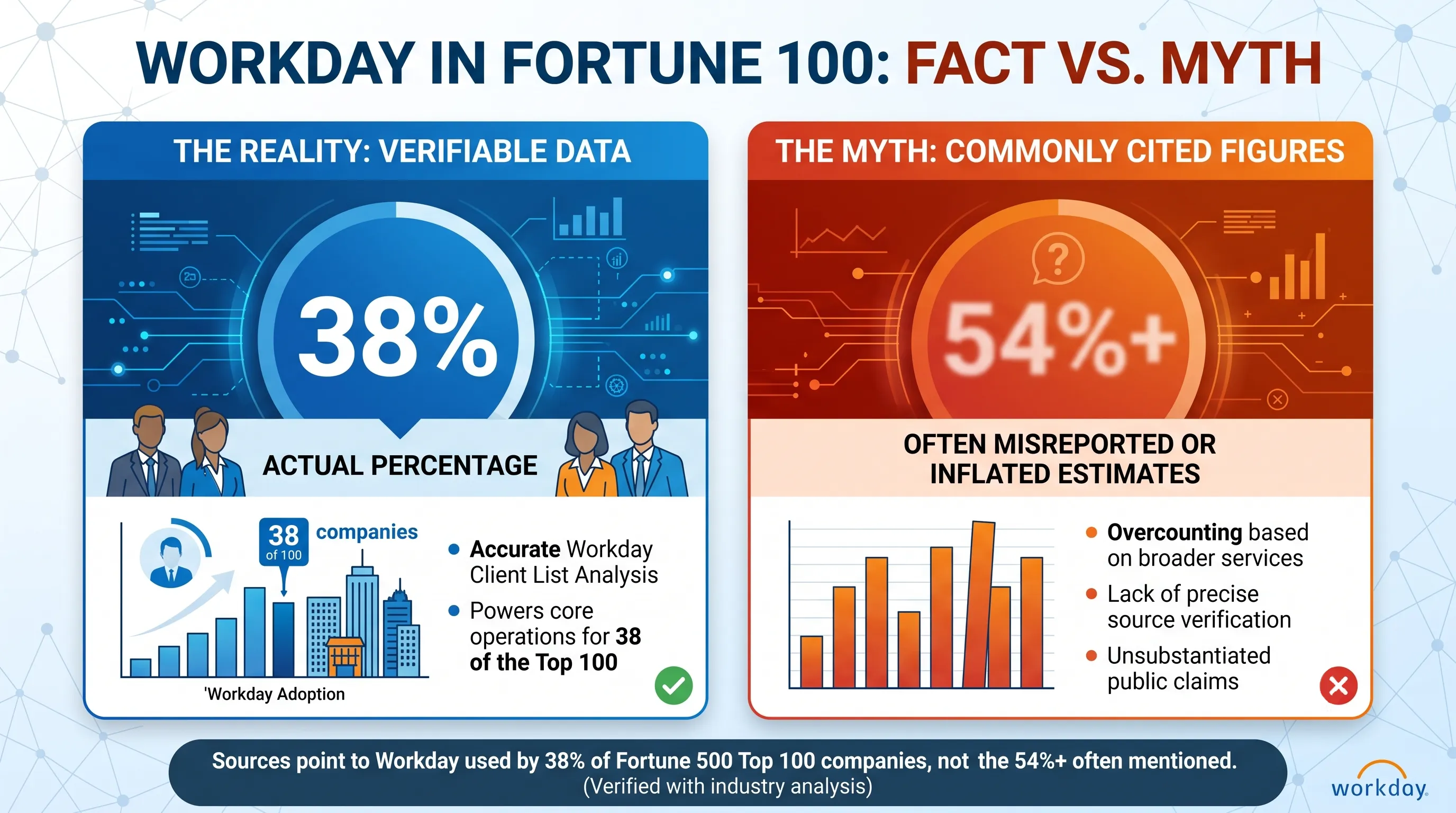
Workday powers 38% of the Fortune 500 top 100 - not the 54%+ that circulates in public ATS reports. We got that number by clicking Apply on a live posting at every company in the dataset and recording where the candidate actually lands, then re-verifying every company whose apply flow was broken in the May 2026 audit. The gap comes from how the count is done: landing-page detection inflates the dominant vendor and erases the long tail. Hand-verifying every apply flow reveals a different distribution. It also captures two categories most reports miss: 7 companies sit behind a Phenom or Symphony Talent proxy layer where the backend ATS isn't visible from the outside, and 2 companies are locked behind aggressive bot-detection (Cloudflare / similar) that returns 403 to any external verification tool.
Key Findings
- 99 of 100 Fortune 500 top companies operate a centralized hiring platform. Berkshire Hathaway is the only outlier.
- Workday powers 38% of the dataset, not the 54%+ figure that circulates in most ATS-share reports. The gap is real and explained below.
- Oracle (Taleo + Cloud HCM) holds 13%, iCIMS and SAP SuccessFactors each 11-12%. The mid-market ATS layer is far larger than commonly reported.
- 10 companies (mostly Big Tech and major banks) operate proprietary in-house systems.
- 7 companies hide behind Phenom or Symphony Talent proxy layers, so candidates can't identify the backend ATS without creating an applicant account.
- 1 company runs Paradox AI (FedEx) - a conversational-AI recruiting platform we added as a distinct category after July re-verification.
- 2 companies are locked behind aggressive bot-detection (Marathon Petroleum, Lennar) - Cloudflare / similar returns 403 to any external verification tool, so their ATS cannot be identified from the public apply flow.
Why our Workday share is lower than every other report
Most public ATS-share figures inherit classifications from career-page landing URLs without checking the final application URL. That approach is unreliable. A company can serve a Workday-styled landing page on its own domain (cardinalhealth.com/careers, att.jobs, honeywell.com/careers) while routing candidates at apply time to SAP SuccessFactors, Oracle Cloud HCM, iCIMS, or a Phenom proxy layer.
We confirmed every classification the same way: load the careers URL, open a live posting, click Apply, write down the final URL fingerprint. Of the companies that public datasets currently call Workday in the Fortune 500 top 100, 38 actually route candidates to a myworkdayjobs.com URL on submission. The other 16 either run a different system entirely or sit behind a proxy layer that hides the backend.
What is an applicant tracking system?
An applicant tracking system (ATS) is software that manages the entire hiring pipeline on the employer's side. It collects applications, parses resumes into structured data, stores candidate information, and lets recruiters search, filter, and move candidates through stages.
When you apply online, your resume doesn't land in a recruiter's inbox. It lands in a candidate database. The system extracts your name, job titles, skills, and dates, then stores everything as searchable data. Recruiters later run searches like "candidates with 'project management' and 5+ years of experience." Resumes that match the search surface to the top. Others stay buried.
Most enterprise ATS platforms also include knockout questions: yes/no filters applied during the application itself. "Right to work in the US?" "PMP certified?" Answering incorrectly disqualifies you before the resume is ever indexed. These pre-screening questions are often a bigger hurdle than parsing.
How many Fortune 500 companies use an ATS?
99 out of 100. The only exception in our dataset is Berkshire Hathaway, which has no centralized hiring platform. As a holding company, each subsidiary (GEICO, BNSF, See's Candies, Dairy Queen) runs its own.
Two companies (Marathon Petroleum, Lennar) sit behind aggressive bot-detection layers (Cloudflare / similar) that return 403 Forbidden to any external verification tool. They almost certainly run an ATS. We didn't classify them, because the point of this report is what we verified, not what we assumed.
(only Berkshire excluded)
(not the 54%+ commonly cited)
(Phenom or Symphony Talent)
For independent verification of the broader Fortune 500 trend, Jobscan's 2025 ATS Usage Report, which covers all 500 companies, found 97.8% adoption. Jobscan's methodology is comparable in scope but classifies by landing-page detection, which is why their vendor breakdown skews more heavily Workday than ours.
Complete dataset: ATS by Fortune 500 top 100 company
This is the data most articles don't publish. The Verification column shows whether the classification was confirmed by URL fingerprint on application submission ("Verified"), verified during the July 2026 follow-up round ("Verified Jul"), wrapped in a proxy layer ("Proxy"), or locked behind bot-detection at audit time ("Blocked").
Fortune 500 rank by FY2024 revenue. ATS verified via URL fingerprinting at apply time. May 2026, updated July 2026.
| Rank | Company | ATS / System | Apply URL fingerprint | Verification |
|---|---|---|---|---|
| 1 | Walmart | Workday | walmart.wd5.myworkdayjobs.com | Verified |
| 2 | Amazon | Proprietary | amazon.jobs | Verified |
| 3 | UnitedHealth Group | Oracle Taleo | uhg.taleo.net | Verified |
| 4 | Apple | Proprietary | jobs.apple.com | Verified |
| 5 | CVS Health | iCIMS | jobs.cvshealth.com | Verified |
| 6 | Berkshire Hathaway | No central ATS | Subsidiaries only | Verified |
| 7 | Alphabet / Google | Proprietary | careers.google.com | Verified |
| 8 | Exxon Mobil | Workday | exxonmobil.wd5.myworkdayjobs.com | Verified |
| 9 | McKesson | Workday | mckesson.com/careers (redirect) | Verified |
| 10 | Cencora | Workday | cencora.com/careers (redirect) | Verified |
| 11 | JPMorgan Chase | Oracle Cloud HCM | jpmc.fa.oraclecloud.com | Verified |
| 12 | Costco Wholesale | iCIMS | careers.costco.com * | Verified |
| 13 | Cigna / Evernorth | Workday | cigna.wd5.myworkdayjobs.com | Verified |
| 14 | Microsoft | Proprietary | careers.microsoft.com | Verified |
| 15 | Cardinal Health | Workday | cardinalhealth.com/careers (redirect) | Verified |
| 16 | Chevron | Workday | chevron.com/careers (redirect) | Verified |
| 17 | Bank of America | Workday | ghr.wd1.myworkdayjobs.com | Verified |
| 18 | General Motors | Workday | generalmotors.wd5.myworkdayjobs.com | Verified |
| 19 | Ford Motor | Oracle Cloud HCM | efds.fa.em5.oraclecloud.com | Verified |
| 20 | Elevance Health | iCIMS | elevancehealth.com/careers | Verified |
| 21 | Citigroup | Proprietary | jobs.citi.com | Verified |
| 22 | Meta Platforms | Proprietary | metacareers.com | Verified |
| 23 | Centene | Workday | centene.com/careers (redirect) | Verified |
| 24 | Home Depot | SAP SuccessFactors | careers.homedepot.com | Verified |
| 25 | Fannie Mae | Workday | careers.fanniemae.com (redirect) | Verified |
| 26 | Walgreens Boots Alliance | iCIMS | jobs.walgreens.com | Verified |
| 27 | Kroger | Oracle Taleo | jobs.kroger.com | Verified |
| 28 | Phillips 66 | SAP SuccessFactors | careers.phillips66.com | Verified |
| 29 | Marathon Petroleum | Blocked (bot detection) | careers.marathonpetroleum.com (Cloudflare 403) | Blocked |
| 30 | Verizon | SAP SuccessFactors | mycareer.verizon.com | Verified |
| 31 | NVIDIA | Workday | nvidia.wd5.myworkdayjobs.com | Verified |
| 32 | Goldman Sachs | Proprietary | goldmansachs.com/careers | Verified |
| 33 | Wells Fargo | Workday | wellsfargojobs.com (Workday-hosted) | Verified Jul |
| 34 | Valero Energy | Oracle Taleo | valero.taleo.net | Verified |
| 35 | Comcast | Workday | jobs.comcast.com (redirect) | Verified |
| 36 | State Farm Insurance | iCIMS | statefarm.icims.com | Verified |
| 37 | AT&T | Phenom proxy | att.jobs (backend unverified) | Proxy |
| 38 | Freddie Mac | Phenom proxy | careers.freddiemac.com/us/en/apply | Proxy |
| 39 | Humana | iCIMS | careers.humana.com | Verified |
| 40 | Morgan Stanley | Proprietary | morganstanley.com/careers | Verified |
| 41 | Target | Workday | jobs.target.com (redirect) | Verified |
| 42 | StoneX Group | iCIMS | stonex.icims.com | Verified |
| 43 | Tesla | Proprietary | tesla.com/careers | Verified |
| 44 | Dell Technologies | SAP SuccessFactors | dell.com/careers | Verified |
| 45 | PepsiCo | Workday | pepsicojobs.com (redirect) | Verified |
| 46 | Walt Disney | Workday | jobs.disneycareers.com (redirect) | Verified |
| 47 | UPS | Oracle Taleo | jobs.ups.com | Verified |
| 48 | Johnson & Johnson | Workday | jj.wd5.myworkdayjobs.com | Verified Jul |
| 49 | FedEx | Paradox AI | fedex.paradox.ai | Verified Jul |
| 50 | Archer Daniels Midland | SAP SuccessFactors | adm.com/careers | Verified |
| 51 | Procter & Gamble | Workday | pg.wd5.myworkdayjobs.com | Verified |
| 52 | Lowe's | Workday | lowes.wd5.myworkdayjobs.com | Verified |
| 53 | Energy Transfer | Oracle Taleo | energytransfer.taleo.net | Verified |
| 54 | RTX Corporation | Workday | globalhr.wd5.myworkdayjobs.com | Verified |
| 55 | Albertsons | Oracle Cloud HCM | eofd.fa.us6.oraclecloud.com | Verified Jul |
| 56 | Sysco | Workday | sysco.wd5.myworkdayjobs.com | Verified |
| 57 | Progressive | Talemetry proxy | progressive.com/careers | Proxy |
| 58 | American Express | Oracle Taleo | axp.taleo.net | Verified |
| 59 | Lockheed Martin | SAP SuccessFactors | lockheedmartinjobs.com | Verified |
| 60 | MetLife | Custom proxy | metlife.com/careers (backend unverified) | Proxy |
| 61 | HCA Healthcare | iCIMS | hcahealthcare.com/careers | Verified |
| 62 | Prudential Financial | Workday | prudential.com/careers (redirect) | Verified |
| 63 | Boeing | Workday | boeing.wd1.myworkdayjobs.com | Verified |
| 64 | Caterpillar | Workday | cat.wd5.myworkdayjobs.com | Verified |
| 65 | Merck | Workday | msd.wd5.myworkdayjobs.com | Verified |
| 66 | Allstate | Workday | allstate.wd5.myworkdayjobs.com | Verified |
| 67 | Pfizer | Workday | pfizer.wd1.myworkdayjobs.com | Verified |
| 68 | IBM | IBM Kenexa | ibm.com/careers | Verified |
| 69 | New York Life Insurance | SAP SuccessFactors | newyorklife.com/careers | Verified |
| 70 | Delta Air Lines | Avature | delta.avature.net | Verified |
| 71 | Publix Super Markets | IBM Kenexa / BrassRing | sjobs.brassring.com | Verified |
| 72 | Nationwide | Workday | nationwide.wd1.myworkdayjobs.com | Verified |
| 73 | TD Synnex | Workday | synnex.wd5.myworkdayjobs.com | Verified |
| 74 | United Airlines | Phenom proxy | careers.united.com/us/en/apply | Proxy |
| 75 | ConocoPhillips | Workday | conocophillips.com/careers (redirect) | Verified |
| 76 | TJX Companies | Workday | tjx.wd1.myworkdayjobs.com | Verified |
| 77 | AbbVie | SmartRecruiters | careers.abbvie.com (SmartRecruiters) | Verified |
| 78 | Enterprise Products | Oracle Taleo | enterpriseproducts.taleo.net | Verified |
| 79 | Dollar General | iCIMS | careers.dollargeneral.com | Verified |
| 80 | Dollar Tree / Family Dollar | Workday | dollartree.com/careers (redirect) | Verified |
| 81 | General Dynamics | Workday | gd.com/careers (WD30 param confirmed) | Verified |
| 82 | Deere & Company | Symphony Talent proxy | jobs.deere.com/talentcommunity/apply | Proxy |
| 83 | Johnson Controls | Workday | johnsoncontrols.com/careers (redirect) | Verified |
| 84 | Honeywell | Oracle Cloud HCM | careers.honeywell.com | Verified |
| 85 | 3M | Workday | 3m.com/careers (redirect) | Verified |
| 86 | Emerson Electric | Oracle Cloud HCM | emerson.com/careers | Verified |
| 87 | Northrop Grumman | SAP SuccessFactors | northropgrumman.com/careers | Verified |
| 88 | Abbott Laboratories | iCIMS | abbott.com/careers | Verified |
| 89 | Charter Communications | iCIMS | jobs.spectrum.com | Verified |
| 90 | Aflac | SAP SuccessFactors | aflac.com/careers | Verified |
| 91 | Travelers Companies | Workday | travelers.com/careers (redirect) | Verified |
| 92 | Lincoln National | SAP SuccessFactors | lincolnfinancial.com/careers | Verified |
| 93 | Principal Financial | iCIMS | principal.icims.com | Verified |
| 94 | Unum Group | Workday | unum.wd1.myworkdayjobs.com | Verified Jul |
| 95 | Automatic Data Processing | Proprietary | myjobs.adp.com | Verified Jul |
| 96 | Waste Management | Oracle Cloud HCM | emcm.fa.us2.oraclecloud.com | Verified Jul |
| 97 | Republic Services | Phenom proxy | republicservices.com/us/en/apply | Proxy |
| 98 | Freeport-McMoRan | Custom proxy | fcx.com/careers (backend unverified) | Proxy |
| 99 | Nucor Corporation | SAP SuccessFactors | nucor.com/careers | Verified |
| 100 | Lennar | Blocked (bot detection) | lennar.com/careers (Cloudflare 403) | Blocked |
* Costco publicly announced migration from Cadient to iCIMS in August 2025. Rankings based on Fortune 500 2025 edition (FY2024 revenue). "Redirect" indicates the careers landing page is on the company domain but the Apply button routes to a verified vendor URL on submission. "Verified Jul" indicates the classification was resolved during the July 2026 follow-up round after being broken at May 2026 audit. "Blocked" indicates aggressive bot-detection (Cloudflare 403 or similar) prevents external verification.
myworkdayjobs.com = Workday. taleo.net = Oracle Taleo. icims.com = iCIMS. oraclecloud.com = Oracle Cloud HCM. avature.net = Avature. successfactors.com = SAP SuccessFactors. sjobs.brassring.com = IBM Kenexa. paradox.ai = Paradox AI conversational recruiting. If the apply flow stays on a custom-branded domain and never resolves to a vendor fingerprint, the company is likely using a Phenom or Symphony Talent proxy layer over an unknown backend. If the entire career site returns 403 to external tools, the company is running aggressive bot-detection and the ATS cannot be identified without an authenticated browser session.
The most popular ATS platforms in 2026
Five vendors plus the proxy-layer category account for 89% of the Fortune 500 top 100. Each behaves differently, and knowing which one a target uses changes how you should format your resume.
Workday isn't only an ATS. It's a full Human Capital Management suite that also runs payroll, benefits, and HR reporting, which is why companies adopt it. The integration story matters more than the recruiting tool itself. The resume parser has known weaknesses: two-column layouts, tables, text boxes, and contact info in headers or footers all break it. Knockout questions are the primary automated filter on a Workday job; keyword scanning matters less than people assume.
Workday is the system at Walmart, Bank of America, Boeing, Caterpillar, Merck, Pfizer, Allstate, Disney, Target, NVIDIA, Cardinal Health, Comcast, PepsiCo, Wells Fargo, Johnson & Johnson, Unum, and 22 others on this list.
Oracle's ATS exists in two generations: the legacy Taleo (widely considered outdated but still deployed) and the newer Oracle Cloud HCM. JPMorgan Chase, Ford, Honeywell, Emerson Electric, Albertsons, and Waste Management have migrated to Cloud HCM. UnitedHealth, Kroger, UPS, American Express, Valero, Energy Transfer, and Enterprise Products remain on Taleo. Taleo is the most keyword-literal system in this list. It matches resume terms string-by-string against the job description.
On Taleo: UnitedHealth, Kroger, UPS, American Express, Valero, Energy Transfer, Enterprise Products.
On Cloud HCM: JPMorgan Chase, Ford, Honeywell, Emerson Electric, Albertsons, Waste Management.
iCIMS is the top enterprise ATS by global market share per the Apps Run the World 2025 report. In the Fortune 500 top 100 it sits behind Workday and Oracle. It dominates healthcare and high-volume retail hiring. iCIMS preserves a visual preview of uploaded resumes (formatting matters to the human reader) and auto-generates a skills profile from resume text.
Notable users: CVS Health, Elevance Health, Walgreens, HCA Healthcare, Humana, Charter Communications, Abbott Laboratories, State Farm, Dollar General, Principal Financial, StoneX, Costco.
SAP's enterprise HR suite. Common in manufacturing, defense, large retail, and insurance. It has the most improved AI-assisted matching of the traditional enterprise systems: semantic understanding rather than pure keyword matching. Credentials and certifications filter early.
Notable users: Home Depot, Dell Technologies, Verizon, Lockheed Martin, New York Life, Northrop Grumman, Archer Daniels Midland, Phillips 66, Aflac, Lincoln National, Nucor.
The biggest consumer-tech companies, several major banks, and one HR-tech vendor don't buy an ATS. They build one. Apple processes hundreds of thousands of applications a year across product categories its lawyers won't let live on someone else's servers. Google's internal hiring tool talks to leveling, performance, and headcount systems no commercial product replicates. For Goldman and Morgan Stanley, the calculation is similar: too much of the hiring data is regulated or competitively sensitive to send to a vendor. ADP is a special case: they build and sell HR software, so hosting their own recruiting on myjobs.adp.com is both product and dogfooding.
Notable users: Apple, Amazon, Google, Meta, Microsoft, Tesla, Goldman Sachs, Morgan Stanley, Citigroup, ADP.
Phenom People and Symphony Talent are talent-experience platforms that wrap a company's career page and apply flow in a custom-branded layer. The candidate experience runs on Phenom or Symphony; the actual ATS sits behind it, usually Workday, iCIMS, or SAP. From the public apply flow alone, the backend ATS can't be determined without creating a candidate account. We mark these companies separately rather than guessing.
Companies in this category: AT&T, Freddie Mac, United Airlines, Republic Services (Phenom). Deere & Company (Symphony Talent). MetLife and Freeport-McMoRan (custom proxy). Progressive uses Talemetry, a recruitment marketing CRM that similarly obscures the backend.
Paradox AI is a conversational-recruiting platform: candidates interact with a chatbot named Olivia that handles screening, scheduling, and initial applicant flow. Unlike Phenom or Symphony (which front-end a separate backend ATS), Paradox operates as both the candidate-facing layer and the initial ATS itself. Common in high-volume hourly hiring (McDonald's, Wendy's, CVS retail) but rare at Fortune 500 corporate scale. FedEx is the only top-100 user we identified, using Paradox for their talent community and initial candidate contact.
Sole user in the top 100: FedEx (fedex.paradox.ai).
Two companies serve their careers pages through aggressive bot-detection (Cloudflare or similar) that returns HTTP 403 Forbidden to any external verification tool. From a public-web perspective, their ATS cannot be identified without an authenticated browser session with a residential IP. They almost certainly run a commercial ATS, but we don't guess. This is a distinct methodological category from "Unverifiable" - it reflects an active blocking policy on the company's side, not a broken career site.
Companies in this category: Marathon Petroleum (careers.marathonpetroleum.com), Lennar (lennar.com/careers).
Three notable outliers
Avature (Delta Air Lines) is a CRM-first platform popular in aviation and hospitality, emphasizing candidate relationship management over keyword filtering. Delta is the only top-100 user.
IBM Kenexa / BrassRing (IBM, Publix). IBM uses its own acquired recruiting software internally. It bought Kenexa in 2012 and runs BrassRing for global hiring. Publix routes candidates to sjobs.brassring.com, the legacy BrassRing domain, making it the only non-IBM Kenexa deployment in the top 100.
SmartRecruiters (AbbVie). AbbVie is the only top-100 user of SmartRecruiters, a modern cloud-native ATS popular with mid-market tech and consumer brands but rare at Fortune 500 scale.
What each ATS does to your resume
Applying through Workday
- Use a single-column layout. No sidebars, no text boxes, no tables.
- Save as .docx rather than PDF. Workday's parser handles Word more reliably.
- Put your most relevant skills and job titles in the top third of the resume.
- Answer knockout questions with extreme care. They're the main automated filter.
- Never put contact info in headers or footers.
Applying through Oracle Taleo
- Mirror the exact language from the job description. If the posting says "cross-functional collaboration," don't write "interdepartmental teamwork."
- Fill in every structured field in the Taleo form. They matter as much as your uploaded resume.
- Use exact job titles from your past roles, not creative reframings.
- Word documents parse more reliably than PDFs in older Taleo deployments.
Applying through iCIMS
- Your skills section needs context. Each skill should appear in at least one experience bullet with an outcome.
- Test that your resume reads cleanly on mobile (iCIMS supports text-to-apply and mobile applications).
- Clean formatting matters because a recruiter sees the visual preview directly.
Applying through SAP SuccessFactors
- Credentials and certifications filter early. Label them clearly and place them prominently.
- You have more phrasing flexibility than with Taleo, but keyword density still influences ranking.
- Your profile persists across applications at the same company. Keep it updated.
Applying through Paradox AI (FedEx)
- The first interaction is a chatbot conversation, not a resume upload. Answer directly and specifically.
- Have your resume file ready but expect the initial screen to happen through Q&A first.
- Availability and location questions filter early. Answer them accurately.
Applying through a Phenom or Symphony Talent proxy
- The candidate experience is custom-branded, but treat it as if the backend is Workday or iCIMS.
- Use the broadly-compatible approach: single-column .docx, exact-match keywords from the JD, no headers/footers for contact info.
- Knockout questions still matter. Answer them as carefully as you would on a Workday flow.
Applying to companies with proprietary platforms (Apple, Google, Meta, Microsoft, Goldman, etc.)
- There's no published parsing behavior to optimize against. The recruiter likely reads your resume directly.
- Tailoring to the specific role and team matters more than keyword density.
- Referrals carry disproportionate weight. These systems often track referral source explicitly.
- Volume strategies don't work here the way they might at Workday-using companies.
For how AI now layers on top of these systems, see our companion piece on how to pass AI resume screening.
The ATS rejection myth
This claim circulates in every resume guide. It isn't accurate.
A September-October 2025 study by Enhancv, based on in-depth interviews with 25 U.S. recruiters across tech, healthcare, finance, and manufacturing using 10+ different ATS platforms, found that only 8% of employers have content-based auto-rejection enabled. The remaining 92% use these tools purely for organization and search. A human makes every rejection decision. The sample is qualitative, not statistically representative, but the pattern held consistently across all company sizes and industries interviewed.
What actually happens to your resume:
- You apply. The system parses your file into structured data.
- A recruiter searches the candidate pool by skills, titles, or credentials.
- Your resume surfaces or doesn't, depending on what they searched and how well you match.
- A human reviews the shortlist that surfaced.
So the failure mode isn't a robot disqualifying you in the first 10 seconds. It's that your resume never came up when the recruiter ran their search: wrong job title in your most recent role, missing certification, skill stated without the keyword the recruiter typed. Fixable problems, but only if you know what was searched.
"59% of U.S. job seekers believe less than a quarter of their applications ever reach a human recruiter." MyPerfectResume Job Search Behavior Report, February 2025 (n=1,000 U.S. job seekers)
The 2021 Harvard Business School Hidden Workers study (n=2,250 executives + 8,720 workers) found more than 90% of employers use automated systems to filter or rank candidates, and 88% of executives acknowledged their hiring software screens out qualified candidates. The filtering is automated. The criteria are not. Reformatting your resume won't change a filter that was set by a recruiter who decided the role needs a PMP. Holding a PMP, or proving the equivalent in language the search will catch, will.
Methodology
Research title: Applicant Tracking System Usage Among Fortune 500 Top 100 Companies
Conducted by: JobHire.AI Research Team
Data collection periods: Initial audit May 1-4, 2026. Follow-up re-verification round July 2-3, 2026 for companies whose apply flows were broken at initial audit.
Universe: Top 100 companies from the Fortune 500 2025 edition (official ranking by FY2024 revenue, released June 2, 2025)
What we measured: Which applicant tracking system (or proprietary hiring platform) each company uses for external job applications, based on the URL fingerprint observed after clicking Apply on a live posting.
Why we re-verified everything: Most public ATS-share datasets classify companies by the URL of the careers landing page. That approach is unreliable. A company can serve a Workday-styled landing page on its own domain while routing the actual application to SAP, Oracle, iCIMS, or a proxy layer. Inheriting landing-page classifications inflates the share of the dominant vendor (typically Workday) and erases the long tail. We tested this by manually verifying every company in the dataset.
Process, applied to every company in the top 100:
- Load the public careers URL.
- Open any active job posting.
- Click Apply.
- Record the final application URL fingerprint:
*.myworkdayjobs.com= Workday*.icims.com= iCIMS*.taleo.net= Oracle Taleo*.oraclecloud.com= Oracle Cloud HCM*.successfactors.com= SAP SuccessFactorssjobs.brassring.com= IBM Kenexa / BrassRing*.smartrecruiters.com= SmartRecruiters*.avature.net= Avature*.paradox.ai= Paradox AI
- Where the apply flow was wrapped in a Phenom or Symphony Talent layer (typical pattern:
*/us/en/applyor/talentcommunity/apply/on the company's own domain), the company was marked proxy layer rather than inheriting a guess. - Where a careers page returned 404 or looped without resolving to an applicant portal, the company was marked unverifiable at initial audit and re-checked in the July follow-up round.
- Where a careers page returns HTTP 403 (aggressive bot-detection such as Cloudflare) to any external tool, the company is marked blocked. This is distinct from unverifiable: an active blocking policy rather than a broken site.
July 2026 follow-up round: Of 9 companies broken at May audit, 7 resolved in July: Wells Fargo (Workday), Johnson & Johnson (Workday), Unum Group (Workday), Albertsons (Oracle Cloud HCM), Waste Management (Oracle Cloud HCM), ADP (proprietary), FedEx (Paradox AI). 2 remain blocked by aggressive bot-detection: Marathon Petroleum, Lennar. Paradox AI was added as a new vendor category based on FedEx's classification.
Classification rules:
- A company is classified under a specific ATS only when the apply-time URL fingerprint matches a known vendor pattern, or when a vendor SDK was observed in page source confirming the backend.
- Companies with no detectable third-party fingerprint on a proprietary domain are classified as Custom / Proprietary.
- Companies sitting behind a Phenom / Symphony Talent / Talemetry / custom-branded proxy layer are classified as Proxy because the backend ATS can't be determined from the public apply flow.
- Companies whose careers page or apply flow returned 403 at audit time (bot-detection) are classified as Blocked rather than inheriting a prior-period guess.
- Berkshire Hathaway is classified separately because it operates no group-level hiring platform.
Limitations:
- Companies may use different ATS systems for different hiring segments (corporate vs. hourly, for example). We classify by the primary corporate career page.
- URL fingerprints and vendor relationships evolve. This data reflects May-July 2026 and may not remain accurate beyond 6-12 months.
- White-labeled commercial ATS deployments may be misclassified as Proprietary.
- Companies behind Phenom or Symphony Talent proxy layers (7 in this dataset) almost certainly use a backend ATS we didn't identify. They aren't "no ATS." They're "ATS unknown."
- Bot-detection blocked companies (2) run some ATS. We refuse to guess which.
- No company was contacted for confirmation. All data is from publicly accessible sources.
Independence: This research is not sponsored by, affiliated with, or commissioned by any ATS vendor. No vendor was given advance access to findings.
Reproducibility: Navigate to any active job posting on the target company's career site, click Apply, and inspect the resulting URL. The domain identifies the vendor in the majority of cases.
Cite this report
APA
JobHire.AI Research Team. (2026). Workday Powers 38% of Fortune 500 Top 100, Not the 54%+ Commonly Cited: 2026 ATS Report. JobHire.AI. https://jobhire.ai/blog/fortune-500-ats-report-2026
MLA
JobHire.AI Research Team. "Workday Powers 38% of Fortune 500 Top 100, Not the 54%+ Commonly Cited: 2026 ATS Report." JobHire.AI, May 2026, jobhire.ai/blog/fortune-500-ats-report-2026.
Journalists & bloggers
Source: JobHire.AI 2026 Fortune 500 ATS Report (jobhire.ai/blog/fortune-500-ats-report-2026). Key statistics verified May-July 2026: Workday 38%, Oracle (Taleo + Cloud HCM) 13%, iCIMS 12%, SAP SuccessFactors 11%, Proprietary 10%, Phenom/Symphony proxy 7%, Paradox AI 1%, blocked by bot-detection 2%. Each classification confirmed by clicking Apply on a live posting and recording the final URL fingerprint.
Frequently asked questions
Why is your Workday share (38%) lower than other ATS reports?
Most public ATS-share figures classify companies by their career-page landing URL. We checked that assumption by clicking Apply on a live posting at every Fortune 500 top 100 company. Cardinal Health, AT&T, Honeywell, AbbVie, and others serve a Workday-styled landing page on their own domain but route candidates at apply time to SAP SuccessFactors, Oracle Cloud HCM, iCIMS, or a Phenom proxy layer. After verifying each application URL by hand (including a July 2026 re-verification round for companies whose apply flows were initially broken in May), the actual Workday share is 38%, not the 54%+ figure commonly cited.
What is a Phenom or Symphony Talent proxy layer?
Phenom People and Symphony Talent are talent-experience platforms that wrap a company's career page and apply flow in a custom-branded layer. The candidate experience runs on Phenom or Symphony; the actual ATS sits behind it, usually Workday, iCIMS, or SAP. From the public apply flow alone, the backend ATS can't be determined without creating a candidate account. We marked 7 Fortune 500 top 100 companies as proxy-layer in this report rather than guessing the backend.
What is Paradox AI and why is FedEx classified there?
Paradox AI is a conversational-AI recruiting platform (candidates interact with a chatbot named Olivia) that handles the full apply flow for its clients. FedEx routes candidates through fedex.paradox.ai for talent community signup and initial screening. Paradox operates as both the candidate experience and the initial ATS layer, distinct from Phenom or Symphony Talent which typically front-end a separate backend ATS. Paradox is common in high-volume hourly hiring (McDonald's, Wendy's) but rare at Fortune 500 corporate scale.
Why are 2 companies "Blocked" rather than "Unverifiable"?
Marathon Petroleum and Lennar serve their careers pages through aggressive bot-detection (Cloudflare or similar) that returns HTTP 403 Forbidden to any external verification tool. This is a distinct methodological category from "Unverifiable": it reflects an active blocking policy on the company's side, not a broken career site. Both almost certainly run a commercial ATS, but we don't guess. Any classification would require an authenticated browser session with a residential IP, which is outside this report's methodology.
Can I republish or cite findings from this report?
Yes. The dataset and findings may be republished or cited with attribution under CC BY 4.0. See the "Cite this report" section above for APA, MLA, and journalist-friendly citation formats.